Littleton Volunteer Corps

Terry Stader, KA8SCP, writes on the PART-List:

Last night, Wed. May 8th, I had the privilege to speak to the Littleton Volunteer Corps at the Littleton Fire station to about 20 participants. This group will be serving as a team to work as CERT and MRC combined to support their community in various roles. Last night I spoke to them about the resource of Amateur Radio. Some of the attendees were hams, but most were not. Those not initially familiar became very interested and asked about what it takes to become a ham (Question: What does “ham” mean? was asked). Several of this team had been to SKYWARN training and learned how Amateur Radio and NWS work together in this program. We talked about ARES and RACES as well as the history of PART.

The take away from this meeting is a future evaluation and testing the communications challenges from several locations around the  community. Down the road, maybe the group will do a drill or exercise to test their ability to provide services needed.

So, Littleton hams (and others too), we may be looking for some of your time to work with this team and even become a contributor to providing your skills in communications.


NBEMS Demo at South Shore Hospital

Cape Cod and Islands District Emergency Coordinator Frank O’Laughlin, WQ1O, presented on VHF/UHF Narrow-Band Emergency Message System (“NBEMS”) at an Eastern Massachusetts Hospital Net meeting at the South Shore Hospital in Weymouth on April 6, 2019.

According to O’Laughlin, the meeting was “well attended by many, including Assistant DEC Henry Brown, K1WCC, and Section Emergency Coordinator Rob Macedo, KD1CY. “

HF Operations on Marathon Monday

Marc Stern, WA1R, writes:
 
The Massachusetts HF Net will open sign-on Monday morning at 6 a.m. in standby mode in support of Marathon operations and will remain in this mode until at least 1800 hours local time. Eastern Mass. ARES leadership has asked all amateurs not involved directly to also standby.
 
This year, like last year, there will likely be rain starting about the time runners gather for the morning’s run. Unlike last year, which was complicated by energy-sapping cold and rain, this year’s rain is supposed to be warm and there is a chance of thunderstorms and lightning that will potentially cause runners problems.
 
For HF operations, the Weather Service station, WX1BOS, will be on the air and MEMA HQ will be on the air under the call WC1MA. The HF net will operate on its primary frequency, 3.930.
 
Thanks in advance,
 
73,
 
Marc, WA1R
DEC-HF EMA ARES

HF Coord/MEMA

Storm & Boston Marathon Weather Coordination Message #2 – Monday April 15th, 2019

Rob Macedo, KD1CY, writes on wx1box.org:

.Strong Storm System will bring mild temperatures through Southern New England including along the Boston Marathon route along with the potential for rain and heavier downpours and potentially isolated thunderstorms with attendant lightning risk. There is also the potential for strong winds during Marathon Monday under any heavier rain showers and thunderstorms and then as a cold front pass through the area late Monday Afternoon as the marathon ends, through Monday Night and into early Tuesday Morning..

..Boston Marathon volunteers and runners should prepare for the rain and changeable temperatures with largely mild conditions but a slightly cool start and a cooler mid to late afternoon from west to east across the marathon route..

[Full story]

KA8SCP to Present on Emergency Communications, Nashoba Valley ARC, April 18, 2019

Terry Stader, KA8SCP, will be the featured speaker at the Nashoba Valley ARC‘s April 18 meeting in Pepperell. A member of PART of Westford, Stader is involved in Massachusetts RACES. He’s a D-STAR coordinator for numerous repeaters, an ARRL District Emergency Coordinator, and the MEMA Region One Communications/RACES Officer.

NVARC meetings are held on the third Thursday of the month at 7:30 PM in the Pepperell Community Center, 4 Hollis Street, Pepperell, MA.

Eastern Massachusetts ARES Net for Monday April 1 at 8:30pm

Hello to all…

The monthly ARES Net is Monday April 1, at 8:30 PM on the MMRA Repeater system.

We had an issue with last months net but that has been resolved.

For frequencies that will be linked into the ARES Net on the MMRA Network, please see the following link from the MMRA web site detailing the repeaters that will be linked in through Hub 1:

http://www.mmra.org/repeaters/repeater_index_by_linkstate.html

We look forward to your participation and remember, we are always looking for Net Controls to run the ARES Net. As part of our relationship with MARS and our own situational awareness gathering we will be asking for any known infrastructure issues that you are aware of. The information must either be personally observed, or obtained “over the air” via amateur radio. Items considered to be infrastructure include but are not limited to: electrical power, water, medical facilities, sanitation, communications, and transportation. Examples of failure would be: small or large area power failure, water main breaks, hospitals’ ER closed, sewage issues, TV/radio station off the air (including public safety), interstate highway or major road closed. No known issues are just as important as reporting failures.

Additionally we are interested in relay of any weather information from airport ATIS/ASOS stations that you can directly receive via radio. These stations broadcast continuously in the 120.000 – 138.000 MHz frequency range using amplitude modulation. Information from the ATIS should include airport, temperature, altimeter (barometer), wind, precipitation, and visibility.A list of stations with their frequencies and a map can be found at: <https://www.faa.gov/air_traffic/weather/asos/?state=MA>. A brief introduction to ATIS can be found at: <https://www.vatsim.net/pilot-resource-centre/general-lessons/understanding-atis>. We will have several interesting announcements for the net that evening and we look forward to everyone’s participation.

Updates will be posted via email and on the Eastern Massachusetts ARES Web Site at <https://ema.arrl.org/ares>. Thanks for your continued support of ARES!

Rob Macedo, KD1CYEastern Massachusetts ARES Section Emergency Coordinator

2019 SKYWARN Training Schedule Posted

SKYWARN logoRob Macedo, KD1CY, writes on WX1BOX.org:

The 2019 NWS Boston/Norton SKYWARN Training Class Schedule for the spring season [has been posted]. Please distribute widely to anyone interested in becoming a SKYWARN Spotter! Additional SKYWARN Training classes are in planning. This includes a class in the Rowe/Charlemont, Mass area, Granby/Hartland, CT area, Western Hampshire County Massachusetts, Eastern Franklin County Massachusetts and potentially other locations in Rhode Island and Southeast Massachusetts. Another update will be posted to the schedule in one to two weeks. There will also be a slate of SKYWARN classes in the Fall of this year. [Full story]

“Ham Operators Train for the Worst”

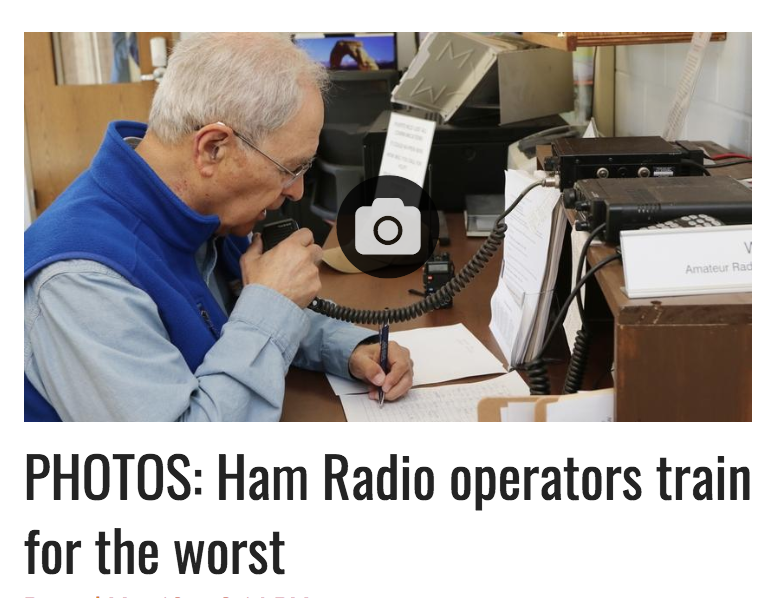
The Maynard Wicked Local online newspaper featured a story with numerous photos on March 18, 2019 entitled, “Ham Operators Train for the Worst.”

“Ham Radio operators from around the area held a drill Monday morning, March 18, 2019, to coordinate coverage in a simulated case of a tornado strike in Hudson, Maynard, Stow and Acton. With the Amature (sic) Radio Emergency Service base in the Stow Fire Department, participants logged in from towns around the area, thereby confirming the coverage available in times of emergency. “

SKYWARN Training, Natick, May 4, 2019

SKYWARN logoThe National Weather Service (NWS) in Boston/Norton Massachusetts will be sponsoring a severe weather spotter training session, part of its SKYWARN program.

The session is open to the public at no charge. Amateur Radio operators, emergency managers, police, fire, and other first responders are encouraged to attend. Everyone age 16 and older who stays to complete the training will be able to become trained NWS weather spotters.

The training session includes a two-hour thirty-minute computer-based presentation, which discusses the development of thunderstorms, the criteria for “severe” thunderstorms, as well as the cloud features associated with severe thunderstorms and tornados. Additional information will be presented about winter storms and proper snow measurement and reporting of coastal flooding, river, stream, and urban flooding and rainfall measurements. The session will also present the procedure for reporting weather information to the National Weather Service. Safety procedures for the various forms of summer severe weather (severe thunderstorms, tornadoes and lightning), winter storms, and flooding will also be covered in the training session. Anyone attending should bring a pen or pencil and bringing a notebook is optional.

To register, visit <https://www.eventbrite.com/e/skywarn-training-class-natick-ma-tickets-57356953191?aff=ebapi>

Contact Rob Macedo, KD1CY, at rmacedo@rcn.com for any questions or further info on the SKYWARN training class.

ARRL Launches Intro to Emergency Communications Courses for 2019

ARRL’s Lifelong Learning Department is excited to announce the launch of the recently revised Introduction to Emergency Communications (EC-001) course. As part of this new initiative, the course has been updated, beta-tested by a group of course mentors, and transferred into a new online learning platform.

With the closing of the Connecticut Distance Learning Consortium (CTDLC) in mid- 2018, EC-001 lost its virtual home and was taken offline. At that point ARRL’s Emergency Preparedness staff started working with the new Lifelong Learning team to explore short and long-term alternatives for offering the course. After a period of careful evaluation and review, the decision was made to move the course from the previous Moodle platform to a more modern Learning Management System called Canvas, which will be used while the new Lifelong Learning Initiative program is being developed. The EC-001 course will eventually become part of this new, comprehensive online learning environment.

EC-001 is designed to provide basic knowledge and tools for any emergency communications volunteer. We hope this course will be the starting point for you in your service to your community as radio amateurs and inspire you to think outside the box and look at new and useful ways the radio amateur can lend a hand to the public that has given us the trust of our spectrum of skills. With the online format, students can access the course at any time from anywhere during a 9-week period, so you may work according to your own schedule.

“We’re very excited to be able to offer Introduction to Emergency Communications EC-001 once again” states Kris Bickell, ARRL Lifelong Learning Manager. “The Emergency Preparedness staff at ARRL has been incredibly helpful while we’ve worked together to get the course back up and running. And the input from previous EC-001 mentors has been an invaluable part of the testing phase. The timing is right to put the course back online.”

As in the past, students will be able to register and take the course entirely online. The Canvas platform is also mobile-responsive, meaning that students can view the course materials, interact with fellow students, and complete assignments from any mobile device.

Each course will run for nine (9) weeks, with a group of up to 30 students who will be supported by an experienced mentor. There will be no cost for the course, although students must meet certain pre-requisites to be eligible to participate, which are listed on the registration page.

To view the 2019 course schedule and to register: http://www.arrl.org/online-course-registration.

Eastern Massachusetts ARES Net for Monday March 4 at 8:30pm

Hello to all…

The monthly ARES Net for March is Monday the 4th, at 8:30 PM on the MMRA Repeater system.

For frequencies that will be linked into the ARES Net on the MMRA Network, please see the following link from the MMRA web site detailing the repeaters that will be linked in through Hub 1: http://www.mmra.org/repeaters/repeater_index_by_linkstate.html

We look forward to your participation and remember, we are always looking for Net Controls to run the ARES Net. As part of our relationship with MARS and our own situational awareness gathering we will be asking for any known infrastructure issues that you are aware of. The information must either be personally observed, or obtained “over the air” via amateur radio. Items considered to be infrastructure include but are not limited to: electrical power, water, medical facilities, sanitation, communications, and transportation. Examples of failure would be: small or large area power failure, water main breaks, hospitals’ ER closed, sewage issues, TV/radio station off the air (including public safety), interstate highway or major road closed. No known issues are just as important as reporting failures.

Additionally we are interested in relay of any weather information from airport ATIS/ASOS stations that you can directly receive via radio. These stations broadcast continuously in the 120.000 – 138.000 MHz frequency range using amplitude modulation. Information from the ATIS should include airport, temperature, altimeter (barometer), wind, precipitation, and visibility.A list of stations with their frequencies and a map can be found at: <https://www.faa.gov/air_traffic/weather/asos/?state=MA>. A brief introduction to ATIS can be found at: <https://www.vatsim.net/pilot-resource-centre/general-lessons/understanding-atis>. We will have several interesting announcements for the net that evening and we look forward to everyone’s participation.

Updates will be posted via email and on the Eastern Massachusetts ARES Web Site at <https://ema.arrl.org/ares>. Thanks for your continued support of ARES!

Rob Macedo, KD1CY
Eastern Massachusetts ARES Section Emergency Coordinator

March 2, 2019 Eastern MA Hospital Net

Hello Everyone,

Net Control for the March 2,2019 Eastern MA Hospital Net will be W1SSH, The South Shore Hospital Amateur Radio Club . The net will commence at the usual time of 10:AM using the following repeaters in the order listed.

1. Attleboro 147.195 Mhz tone 127.3
2. Boston 145.230 Mhz tone encode 88.5 decode 100.0
3. Plymouth 146.685 Mhz tone 131.8
4. Simplex 147.42 Mhz

The Net will then return to the Attleboro Repeater for final comments and Net closing.

NET Protocol: Please wait for Net Control to ask for Check-ins. When asked to check in please use the standard net check in procedure which is: Here is.., un-key, wait 3 seconds to check for doubling, then give your or your facilities call sign, your first name, and your facility’s name.

We extend an invitation to any health care facility or EOC of any city or town that is served by one of the participating hospitals to join the Net. We also extend an invitation to any RACES or ARES member to check in during the NET.

Any hospital wishing to join the net that needs assistance with equipment or personnel should contact us at ssharc@gmail.com. We can assist you with getting your location on the air.

We are always looking for groups or organizations to try their hand at Net Control duties. If you are interested please let us know. Our goal is to rotate Net Control practice and the experience among as many groups as possible.

We thank the repeater trustees for their generosity in allowing us to conduct the monthly nets and the use of their systems in an actual event. The following list of repeaters are available for our use. Only a few systems are used each month with the selection of those used made by Net Control for that month. More systems are being added to the list on a regular basis.

REMINDER: The BARC Repeater is now using split tone. Boston 145.230 tone encode 88.5 tone decode 100.0

Repeaters
Attleboro 147.195 tone 127.3 (Sturdy Memorial Hospital)
Belmont 145.430 tone 146.2
Boston 145.230 tone encode 88.5 tone decode 100.0
Bridgewater 147.180 tone 67.0
Danvers 145.47 tone 136.5
Dartmouth 147.000 tone 67.0
Fall River 146.805. tone 67.0
Falmouth 147.375 tone 110.9
Mansfield EMA 446.925 tone 100.0
Mansfield 147.015 tone 67.0
Marshfield 145.390 tone 67.0
Norwood 147.210 tone 100.00
Plymouth 146.685 tone 131.8
Salem 146.88 tone 118.8
Sharon 146.865 tone 103.5
Weymouth 147.345 tone 110.9 (South Shore Hospital)
W. Bridgewater 146.775 dcs 244
Wrentham 147.09 tone 146.2

We look forward to hearing you all on the Net.

Respectfully,

John O’
K1JRO

South Shore Hospital Amateur Radio Club – W1SSH
55 Fogg Road, Box 42
South Weymouth, MA 02190

New ARES Plan Approved by ARRL Board of Directors Press Release

The ARRL Board of Directors at their last board meeting approved the new ARES Strategic Plan and on Tuesday 2/19/19 put out a press release on the strategic plan and a link to the finalized ARES plan. Details can be found at the following links:

New Plan Aligns ARES with the needs of served agencies
ARES Strategic Plan

Eastern Massachusetts ARES will be following these plans and will make adjustments to the ARES workshop materials to reflect the new ARES structure and strategic plan.

Massachusetts Emergency Management Agency (MEMA) Has a New State Director – Samantha Phillips

The Massachusetts Governor’s office announced on Wednesday 2/20 that Samantha Phillips will be the new state director of the agency replacing Kurt Schwartz after 30 years of public service in various roles in the commonwealth of Massachusetts. Details on the new state director and the changes in MEMA leadership can be seen in the following state press release:

Baker-Polito Administration Names Samantha Phillips as MEMA Director

Falmouth ARA Participation in “Operation Shake Up”

Matthew Trott, KB1MLP, Falmouth Amateur Radio Association Public Relations Officer writes:

Members of the Falmouth Amateur Radio Association/Cape Cod ARES participated in ARES drill “Operation Shake Up” on February 9 with surrounding Amateur Radio clubs and home stations.

The purpose of the drill was to test the capability in establishing communications with stations both within and outside of our district. The drill also tested communications capabilities with our hospital station, primary stations, EOC, shelters, and other ARES members’ home stations. Various field sites participated across Cape Cod, including: Falmouth, Sandwich, Harwich, Joint Base Cape Cod, Martha’s Vineyard, and Nantucket. In addition, home stations participated from as far away as Acushnet, Massachusetts. Communications utilized 2-meter and 70 cm FM, 75 and 40 meter SSB, and 2 meters PAC digital. ARES field teams were instructed to bring their own equipment. “Served agency” equipment was not used at any time. The Incident Command System (ICS) was assigned prior to the start of operations and used during the exercise.

Falmouth did a great job establishing operations at the Falmouth Hospital, the Falmouth EOC at Falmouth Fire Rescue Headquarters, and the Falmouth Field Site at Falmouth High School. Stations made use of various mobile transceivers, batteries, generators, amplifiers, and home brew antennas. Net control at the Falmouth Hospital did a great job in directing the operation. A lot was learned.

Drills and exercises like “Operation Shake Up” are very important in encouraging participation among  Falmouth Amateur Radio Association members and are an important part of FARA’s continuing commitment to community service.

Local Communities Looking for RACES Officers

A few months ago, the Massachusetts Emergency Management Agency conducted a survey for all local community emergency management directors across the Commonwealth. The survey was specifically about the use of amateur radio and RACES locally within their community, whether each emergency manager has an appointed RACES Officer, and if not, if they would like to find one.


The Radio Amateurs Civil Emergency Service (RACES) is a radio service using amateur stations for emergency management communications during periods of local, regional or national emergencies. RACES is defined in law in Part 97.407 of the FCC rules. In the event the U.S. President ever needed to silence the regular Amateur Radio Service by invoking the War Powers Act of 1941, only RACES appointed stations could continue to operate and assist their appointed served agencies.

As a result of the survey conducted by MEMA, the list of communities below are interested in locating an amateur radio operator to serve as their RACES Officer.

If you are interested in any of these appointments, please inquire with that community’s emergency management director. It is also highly recommended to discuss the matter with MEMA Regional RACES Officer which services that local community’s county. We might be able to recommend you based on whatever previous amateur radio EmComm or other public service you’ve done that we’re aware of. We may also be able to give you additional insight into the role in that community.

The MEMA Regional RACES Officers are:
Region 1: Terry Stader KA8SCP
Region 2: Mike Leger N1YLQ
Region 3: Frank Morrisino K1LMY
Region 4: Gil Hayes WK1H

Communities looking for RACES Officers:

  • MEMA Region 1 (Suffolk, Middlesex and Essex Counties)
    • Nahant
    • Belmont
    • Manchester-by-the-Sea
    • North Reading
    • Revere
  • MEMA Region 2 (Norfolk, Bristol, Plymouth, Barnstable, Dukes and Nantucket Counties)
    • Rochester
    • Marshfield
    • Barnstable
    • Yarmouth
    • East Bridgewater
    • Somerset
    • Chilmark
    • Edgartown
  • MEMA Region 3 (Franklin, Hampden, Hampshire and Berkshire Counties)
    • Sandisfield
    • Washington
    • South Hadley
    • Colrain
    • Stockbridge
    • Huntington
    • West Springfield
    • Russell
    • Chesterfield
  • MEMA Region 4 (Worcester County)
    • West Boylston
    • Ashburnham
    • Sterling
    • Sturbridge
    • Fitchburg
    • Grafton
    • Royalston
    • West Brookfield
    • Sutton

February RACES nets on Monday Feb. 4 HF net at 6:45 PM EST, Region 2D VHF net at 7:30 PM EST

The first Monday of every month, unless the first Monday is a holiday, is a test of the Massachusetts RACES and ARES communication capabilities. If the first Monday of the month is a holiday, then the test is delayed one week and will be held the following Monday.

For February, the first Monday of the month is Monday Feb. 4.

********************************************************************************

6:45 PM EST HF net: using the following frequency plan:

We will start at 3930 KHz moving up to 3955 KHz until there is a clear frequency,

Marc Stern WA1R will be net control.

*********************************************************************************

Region 2D VHF net

7:30 PM EST VHF net on 146.865 MHz PL 103.5 (Sharon Repeater)

We will have a general call up of any RACES, ARES, or other interested stations. This willbe followed by a SIMPLEX test..

Jeff Marden N1JCM will be net control.

********************************************************************************

We look forward to you checking in.


73,
AB1PH
Don Rolph
__._,_.___

Eastern MA Hospital Net Schedule, February 2, 2019

John O’Neill, K1JRO writes:

Net Control for the February 2,2019 Eastern MA Hospital Net will be W1SSH, the South Shore Hospital Amateur Radio Club . The net will commence at the usual time of 10 AM using the following repeaters in the order listed. 

  1. Sharon 146.865 tone 103.5
  2. Boston 145.230 tone encode 88.5 tone decode 100.0
  3. Danvers 145.47 tone 136.5
  4. Plymouth 146.685 tone 131.8
  5. 5. Simplex 147.42

The Net will then return to the Sharon Repeater for final comments and Net closing.

NET Protocol: Please wait for Net Control to ask for Check-ins. When asked to check in please use the standard net check in procedure which is:   Here is.., un-key, wait 3 seconds to check for doubling, then give your or your facilities call sign, your first name, and your facility’s name.

We extend an invitation to any health care facility or EOC of any city or town that is served by one of the participating hospitals to join the Net. We also extend an invitation to any RACES or ARES member to check in during the NET.

Any hospital wishing to join the net that needs assistance with equipment or personnel should contact us at ssharc@gmail.com. We can assist you with getting your location on the air.

We are always looking for groups or organizations to try their hand at Net Control duties. If you are interested please let us know. Our goal is to rotate Net Control practice and the experience among as many groups as possible.

We thank the repeater trustees for their generosity in allowing us to conduct the monthly nets and the use of their systems in an actual event. The following list of repeaters are available for our use. Only a few systems are used each month with the selection of those used made by Net Control for that month.  More systems are being added to the list on a regular basis.

REMINDER: The BARC Repeater is now using split tone. Boston 145.230 tone encode 88.5 tone decode 100.0

Repeaters

Attleboro 147.195 tone 127.3 (Sturdy Memorial Hospital)
Belmont 145.430 tone 146.2
Boston 145.230 tone encode 88.5 tone decode 100.0
Bridgewater 147.180 tone 67.0
Danvers 145.47 tone 136.5
Dartmouth 147.000 tone 67.0  
Fall River 146.805. tone 67.0
Falmouth 147.375 tone 110.9  
Mansfield EMA  446.925 tone 100.0
Mansfield 147.015 tone 67.0
Marshfield 145.390 tone 67.0      
Norwood 147.210 tone 100.00
Plymouth 146.685 tone 131.8
Salem 146.88 tone 118.8        
Sharon 146.865 tone 103.5    
Weymouth 147.345 tone 110.9 (South Shore Hospital)
W. Bridgewater 146.775 dcs 244 
Wrentham 147.09 tone 146.2

We look forward to hearing you all on the Net.

Respectfully,

John O’
K1JRO   

KD1CY Featured on WeatherBrains Podcast

Rob Macedo, KD1CY featured on WILI SKYWARN interviewEastern MA Section Emergency Coordinator and ARES SKYWARN Coordinator Rob Macedo, KD1CY, was one of three featured guests on the podcast “WeatherBrains” on January 7, 2019. The 90-minute program discussed Amateur Radio, SKYWARN, and the VoIP Hurricane Net. Other guests included Jay Farlow, W9LW, and Jeff Stapel, W8SWX. The audio and YouTube video can be found at https://weatherbrains.com/?p=7531.
 
According to Macedo, “The program was well received by the meteorological panel and those that have watched/listened to date.”