New England Sci-Tech General Course Online, June 20-21, 2020

New England Sci Tech logoTwo day course: SAT-SUN June 20-21, 12:00-6:00 pm Eastern Time each day

For anyone interested in wireless communications and electronics, this ON-LINE course will get you ready to take the Amateur Radio GENERAL license exam. Geared toward adults, as well as junior high, high school, and homeschool students.

Topics range from the science of radio electronics to the FCC rules governing the radio spectrum. Some preliminary preparation is necessary to get the best results from this course.

This is a FULL course taught by a 40-yr veteran teacher, not a discussion group or video service. You will learn so much more than just watching a video.

The FCC General test will be scheduled for an upcoming weekday evening or weekend, as an online test, run by our VE team which has authorization to run online tests.

System Requirements: Computer or Chromebook capable of running ZOOM Meeting, either by Zoom app or through a browser, a built-in camera/mic, and a color printer.

Included with course fee: downloadable lecture study guide and charts, free access to our weekly Online Radio Shop Talk sessions, and a guest pass to the NEAR/STARS Radio Rooms and radio club meetings for 3 months once the facility reopens.

Note that the standard $15 license exam fee is NOT included and must be registered separately; our VE team is authorized to give ONLINE exams, so you can schedule an exam within a week of the course. (Price is $15 across the country.)

One additional member of the same family may take this course for the price of one, if sharing one computer, video screen, and materials.

A few hours before the session you will receive an email with a Zoom link and ID. If you don’t see the email, check your spam filter. If you still don’t see it, call 508-720-4179 for help.

For questions, e-mail bobphinney at nescitech.org or call 508-720-4179.
New England Sci-Tech General Course Online, June 13-14, 2020

New England Sci Tech logoFor junior high and high school students, homeschool students, and adults who already have a Technician level license, this fast-paced, two-day course will get you ready to take the GENERAL license exam. Topics range from the science of radio electronics to the FCC rules governing the radio spectrum.  Some preliminary reading may be helpful to get the best results from this course. Material will be sent approximately a week before the course.

The GENERAL level course runs Saturday, 8:30 am to 5 pm and Sunday, 8:30 am to noon, followed by the FCC General exam at noon, at New England Sci-Tech, 16 Tech Circle, Natick.

Included with course fee: printed handouts, lecture study guide, license fee if tested at our location, a guest pass to the NEAR/STARS Radio Room and radio club meetings for 2 months, and free coffee, tea, or hot chocolate during the course. Up to 2 members of the same family may take this course for the price of one. Please let me know if there will be two of you attending.

For questions, e-mail bobphinney at nescitech.org or call 508-720-4179.

North Shore Radio Association to Resume In-Person VE Sessions at New Location

The North Shore Radio Association will resume in-person volunteer exam sessions beginning this month, according to NSRA VE Coordinator Rick Savage, KB1LYJ. 

“NSRA has a new location for our June 27 exam session–the American Legion lower level, 31 Hermon Street, in  Winthrop.” Rick adds that reservations will be required, and the number of individuals will be limited to 10 but “multiple times may be used.” 

This meeting location will be used for all NSRA exams through the end of the year. 

Social Distancing Exam Sessions Demonstrate Pent-Up Demand for Testing

ARRL VEC logo/bannerFrom ARRL Web:

A recent in-person “social-distancing” amateur radio exam session in Indiana and a “drive-in” session in California are representative of those that are relieving some of the pent-up demand for testing. As the COVID-19 pandemic lumbers on, in-person exam sessions have begun to resume across the US and elsewhere in the world.

“With in-person sessions starting up again around the country, we are hearing the same story from volunteer examiner (VE) teams everywhere,” said ARRL Volunteer Examiner Coordinator (VEC) Maria Somma, AB1FM. “Large numbers of candidates who have been waiting to test are contacting teams and are thankful for the opportunity to sit for an exam. So far, we’ve heard mostly positive results; candidates are very prepared as they’ve had extra time to study. VE teams and candidates are following CDC and state guidelines for social distancing.” [Full story]

Signing Up for Remote Volunteer Exams–One Ham’s Experiences

Ray Cord, K2TGX, writes on the Study Memorial Hospital ARC mailing list:

Fo those who are interested in remote license exams, Kevin, KM1KEV, has put this together. -Ray

—–Original Message—–
From: Kevin Murray <kevin.murray21@verizon.net>
To: raycord@aol.com <raycord@aol.com>
Sent: Tue, May 26, 2020 11:28 am
Subject: Remote Exam

Ray, 

How to Sign Up for a Remote Exam   
   – Register at https://hamstudy.org/
   – Take a practice test and pass.
   – Click Find a Session
   – Look for an open Remote or Online Exam Session       
      – There are a number of Groups doing Online Exams. The sessions get filled quickly! When reading about an exam session, make sure it does not say “This session is full! “

   – Once a session is found, register. You will receive a PIN. Write the PIN down, it will be needed for the exam. There should be directions on how to proceed. Also, how to pay. Each group is doing the remote exam differently. Follow the VE instructions.
   – I took my General Exam with Rexburg Ham group – N7TMS Todd was the coordinator.         
      – I paid using Google Pay at the link provided.
      – I emailed an official copy of my Tech License to N7TMS   
      – I online signed a CSCE/Form 605 for the EXAM
      – I setup Zoom on my Laptop and Phone
      – One day prior to the Exam, I received the Zoom Meeting link
      – The day of the Exam, I joined the Zoom meeting at the appropriate time
      – I displayed my drivers license for identity verification
      – The VEs had me scan my room to make sure there were no materials to aid the test. No physical calculators allowed, only the Windows calculator.   
      – I propped the phone so that the 3 VEs could watch me.
      – I set the Laptop up so only Zoom and the windows calculator were running   
      – I shared control of my Laptop with the VEs so that they could sign me into the Exam using my PIN.
      – The VEs watch you via the phone and the shared desktop screen
      – I took the exam and passed
      – The VEs then released control of my Laptop

   – I took the Exam on a Saturday, the FCC updated the ULS database on Wednesday. Three business days later.
There are a number of groups that are doing Remote Exams that say invite only, including one out of Natick MA. I do not know how to get on the invite list. Maybe one of the club officers could inquire about getting on the invite list. The Natick group is: New England Amateur Radio – (ONLINE) by invitation only   
| Notes: | THIS SESSION IS BY INVITATION ONLY – REGISTER ONLY IF DIRECTED BY NE1AR VE TEAM..DO NOT REGISTER UNLESS YOU HAVE BEEN TOLD TO..EXAM CANDIDATES MUST REVIEW RULES AND PROTOCOL AT https://nescitech.org/exam/ 

Yankee Clipper Contest Club Special Interest Zoom Meetings

YCCC President Dennis Egan, W1UE, writes on the YCCC mailing list:

Since we can’t meet in person for the foreseeable future, and using Zoom allows us to make some presentations that are hard to do in person, I’ve decided to offer four sessions on operating specific contest modes, as outlined below:

Thur May 28   CW
Wed June 10   FT4
Tue June 23    SSB
Thur July 9      RTTY
??                    VHF/UHF

The Zoom Sessions will start at 7 PM and plan to end at 8:30 PM, although if there is enough interest we could stay on until 9 PM.

I am looking for a moderator for the VHF/UHF session, as I don’t know enough about it to do so.

There will be some prepared material, but my hope is that members will step forward and we can make this a participatory roundtable.  I, of course, have my preferences on how to set up N1MM and operate, but there are others that do it just as successfully.

Some of the topics that will be covered in the CW session:

1. Station Tune-up
2. Operating Game Plan
3. RX Tips
4. Tx Tips
5. N1MM+ Setup/Use
6. Telnet
7. How to Get to Carnegie Hall

If you are interested in preparing some material for any of the above sessions, please feel free to contact me.  I hope these will become sessions with a lot of participation and questions answered.

We will also be recording the session, so you can concentrate on what’s being said without having to take copious notes.  It should be available in the day or two after the session.

Log-in Info for the Zoom meetings will be sent out on Wednesday or Thursday for the CW session.

Dennis W1UE
President, YCCC

New England Sci-Tech General Course Online, July 21-24, 2020

New England Sci Tech logoFor anyone interested in wireless communications and electronics, this ON-LINE course will get you ready to take the Amateur Radio GENERAL license exam. Geared toward adults, as well as junior high, high school, and homeschool students.

Topics range from the science of radio electronics to the FCC rules governing the radio spectrum. Some preliminary preparation is necessary to get the best results from this course.

This is a FULL course taught by a 40-yr veteran teacher, not a discussion group or video service. You will learn so much more than just watching a video.

Current offering:

Four day course: Tu-W-Th-F July 21-24, 3:00-6:00 pm Eastern Time each day.

The FCC General test will be scheduled for an upcoming weekday evening or weekend, as an online test, run by our VE team which has authorization to run online tests.

System Requirements: Computer or Chromebook capable of running ZOOM Meeting, either by Zoom app or through a browser, a built-in camera/mic, and a color printer.

Included with course fee: downloadable lecture study guide and charts, free access to our weekly Online Radio Shop Talk sessions, and a guest pass to the NEAR/STARS Radio Rooms and radio club meetings for 3 months once the facility reopens.

Note that the standard $15 license exam fee is NOT included and must be registered separately; our VE team is authorized to give ONLINE exams, so you can schedule an exam within a week of the course. (Price is $15 across the country.)

One additional member of the same family may take this course for the price of one, if sharing one computer, video screen, and materials.

A few hours before the session you will receive an email with a Zoom link and ID. If you don’t see the email, check your spam filter. If you still don’t see it, call 508-720-4179 for help.

For questions, e-mail bobphinney at nescitech.org or call 508-720-4179.
New England Sci-Tech Amateur Extra Course Begins June 1, 2020

New England Sci Tech logoFor anyone interested in wireless communications and electronics, this ON-LINE course will get you ready to take the AMATEUR EXTRA Radio license exam. Geared toward adults, as well as high school and homeschool students.
This is a FULL course taught by a 40-yr veteran teacher, not a discussion group or video service. You will learn so much more than just watching a video.

Topics range from the science of radio electronics to the FCC rules governing the radio spectrum. Recommended text: ARRL Extra Class License Manual, 12th edition, for exams through June 30, 2024, (purchase on ARRL website). Regular practice and study is necessary to get the best results from this course.

NOTE: You MUST have a thorough understanding of the Technician and General material before taking this course.  If you are already a licensed Tech or General but have been away from radio for a while, you may request to audit (at half price) one of our Tech and/or General courses to catch up.

Current offerings:

ONLINE for 8 days, Mondays June 1 – July 20, from 6:00-9:00pm Eastern time. (Content is NEW AE material for the July 2020-2024 exams)

The FCC Amateur Extra test must be registered separately; our VE team is authorized to give ONLINE exams, so you can schedule an exam within a week of the course.

System Requirements: Computer or Chromebook capable of running ZOOM Meeting, either by Zoom app or through a browser, a built-in camera/mic, and a color printer.

Included with course fee: downloadable lecture study guide and charts, free access to our weekly Online Radio Shop Talk sessions, and a guest pass to the NEAR/STARS Radio Rooms and radio club meetings for 3 months once the facility reopens.

One additional member of the same family may take this course for the price of one, if sharing one computer, video screen, and materials.

For questions, e-mail bobphinney at nescitech.org or call 508-720-4179.

Final Reminder: Contest University Online, May 14, 2020

John Dorr, K1AR, writes on the Yankee Clipper Contest Club mailing list:
Good morning everyone!

Just a final reminder that CTU On-Line will be held this Thursday, May 14. Be especially sure to stay connected at the end of the day as there will be a very special presentation of great interest to YCCC members.

Check out https://www.contestuniversity.com/course-outline/ to pre-register
and be ready to go!

[See also: https://ema.arrl.org/2020/04/15/contest-university-usa-2020-on-line-may-14-2020/]

FCC Providing Flexibility to Volunteer Examiners in Developing Remote Testing Methods

ARRL VEC logo/bannerFrom ARRL Web:

05/03/2020–The FCC has clarified that nothing in its rules prohibits remote amateur radio testing, and no prior approval is needed to conduct remote exam sessions.

“The Commission provides flexibility to volunteer examiners and coordinators who wish to develop remote testing methods or to increase remote testing programs already in place,” the FCC said in an April 30 news release. “We recognize that some volunteer examiner coordinators may not have the immediate capacity for widespread remote testing. We expect those volunteer examiner coordinators with limited remote testing capacity to work closely with those requesting such testing to prioritize any available remote testing slots.”

ARRL Volunteer Examiner Coordinator Manager Maria Somma, AB1FM, said she’s gratified to see that the FCC appreciates the need for remote testing. “Many of our VEs and VE Teams have been employing remotely proctored exam sessions with both video and in-person components, and following social-distancing protocols, where necessary” she said. “Some ARRL VE teams have shown great promise in administering exams remotely.” Somma also said that as states begin to lift restrictions, the possibility exists to restart in-person amateur radio exam opportunities.

“We urge our VE teams to keep up to date so they can make informed decisions based on local community guidelines, as each community is unique,” she said. “Our volunteers should use their best judgement when deciding whether or not to begin conducting in-person exam sessions. It is important to us that you feel confident when choosing your course of action, because the health and safety of our VEs and the examinees is the top priority. VE teams that choose to conduct in-person sessions should re-start consistent with local restrictions and guidelines.”

To find amateur radio license exam sessions in your area, visit the ARRL website. Candidates should verify with their VE teams that the exam session is being held and if any special procedures are required to attend. 

ARISS to Experiment with School Contacts Using “Multipoint Telebridge” Approach

ARISS logoFrom ARRL Web:

04/29/2020 – Amateur Radio on the International Space Station (ARISS) is hoping to adopt a concept it’s calling the “multipoint telebridge contact via amateur radio” that will allow stay-at-home students to take part in amateur radio contacts with members of the space station crew. ARISS has used telebridge stations in the past to enable contacts at times when the ISS orbit does not pass overhead to permit a direct radio contact with the school or other location. In a conventional ARISS telebridge contact, an amateur station ground station in a favorable location for an ISS pass on the scheduled day makes the contact and handles two-way audio between the station and the contact site. ARISS said its new multipoint telebridge approach will permit simultaneous reception by families, school faculty, and the public.

“During the last several weeks, efforts to contain the spread of the COVID-19 virus have resulted in massive school closures worldwide,” ARISS said this week in a news release. “In addition, the stay-at-home policies invoked by authorities initially shut down opportunities for ARISS school contacts for the near future.”

ARISS will put its multipoint telebridge scheme to the test during a contact with a group of Northern Virginia students on April 30. For the event, an ARISS telebridge ground station will link with an ISS crew member via radio, and homebound students and their teacher will be linked individually via the telebridge station. Under the teacher’s direction, each at-home student will take a turn to ask the astronaut one question on a prepared list. [Full story]

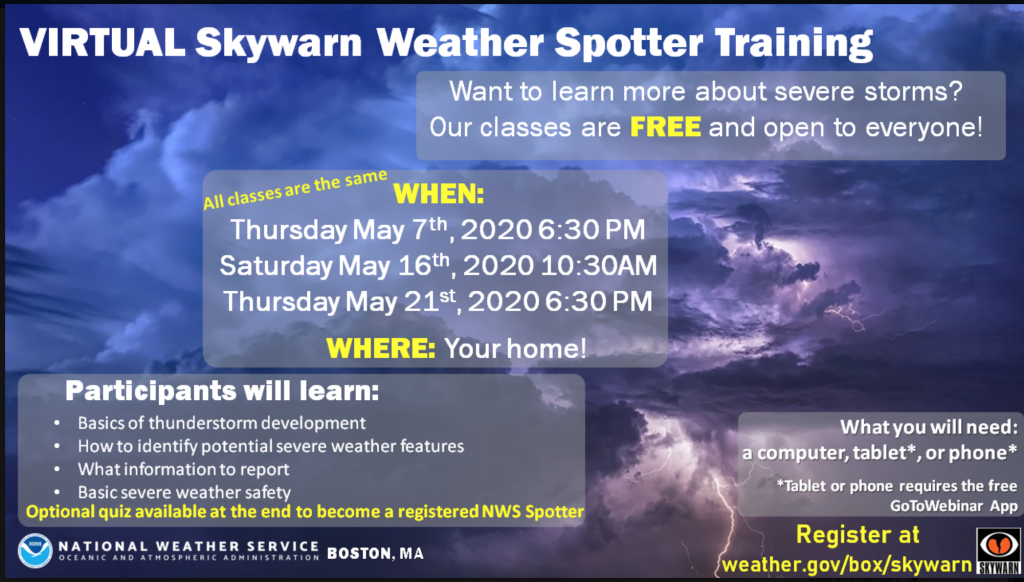
SKYWARN “Virtual” Spotter Training Sessions Offered Beginning May 7, 2020

From: US National Weather Service Boston MA Facebook page:

[PLEASE SHARE] Are you interested in learning about severe thunderstorms & other types of weather? Next Thursday May 7th, is our first of 3 VIRTUAL Skywarn Spotter trainings! It will be provided via GoToWebinar. Register & get a link to the free training @ https://bit.ly/2We5OsK

New England Amateur Radio Inc. Authorized to Administer Fully Online Video-Supervised Volunteer Exams

New England Sci Tech logoNew England Amateur Radio Inc (NE1AR) in collaboration with New England Sci-Tech in Natick, MA, has authorization of the ARRL VEC and the FCC to administer fully online video-supervised exams. These non-profit educational organizations, founded by Bob Phinney, K5TEC, and Ted Reimann, W1OG, and managed by a board of directors, support STEM education for all ages with an emphasis on amateur radio.
 
Bob and Ted began a series of trials on April 1, 2020, under ARRL VEC review and are now supervising a team that provides ARRL approved video-supervised test sessions almost every day of the week. They are also training other ARRL-vetted teams across the country and are working with the software developer of the exam delivery system, ExamTools.org and  HamStudy.org, to help them streamline the system for video-supervised testing.
 
At the moment only one person at a time can be tested, which limits the number of candidates and adds significant time to the VE team’s schedule. An additional time issue is how long it takes a candidate to go through the security protocol involving video-checking the candidate’s work area and room, reading the protocols, getting the electronic surveillance set correctly, etc. Sometimes the setup and followup for an exam takes longer than the exam itself, in order to provide complete integrity of the exam session.
 
According to Bob Phinney,  “People have to understand that we have over a hundred people in the queue, so they have to be patient. We give priority to people who take our online ham courses, then to Amateur Extra candidates who need to test before June 30, and then to local clubs, then to general public.” 
 

New England Sci-Tech Amateur Extra Online Course, June 1-July 20, 2020

New England Sci Tech logoFor anyone interested in wireless communications and electronics, this ON-LINE course will get you ready to take the AMATEUR EXTRA Radio license exam. Geared toward adults, as well as high school and homeschool students.

This is a FULL course taught by a 40-yr veteran teacher, not a discussion group or video service. You will learn so much more than just watching a video.

Topics range from the science of radio electronics to the FCC rules governing the radio spectrum. Recommended text: ARRL Extra Class License Manual, 12th edition, for exams through June 30, 2024, (purchase on ARRL website). Regular practice and study is necessary to get the best results from this course.

NOTE: You MUST have a thorough understanding of the Technician and General material before taking this course. If you are already a licensed Tech or General but have been away from radio for a while, you may request to audit (at half price) one of our Tech and/or General courses to catch up.

Current offerings:

ONLINE for 8 days, Mondays June 1 – July 20, from 6:00-9:00pm Eastern time.
ONLINE for 8 days, Wednesdays July 15 – Sept 2, from 6:00-9:00pm Eastern time.
(Content is NEW AE material for the July 2020-2024 exams)

The FCC Amateur Extra test must be registered separately; our VE team is authorized to give ONLINE exams, so you can schedule an exam within a week of the course.

System Requirements: Computer or Chromebook capable of running ZOOM Meeting, either by Zoom app or through a browser, a built-in camera/mic, and a color printer.

Included with course fee: downloadable lecture study guide and charts, free access to our weekly Online Radio Shop Talk sessions, and a guest pass to the NEAR/STARS Radio Rooms and radio club meetings for 3 months once the facility reopens.

One additional member of the same family may take this course for the price of one, if sharing one computer, video screen, and materials.

For questions, e-mail bobphinney at nescitech.org or call 508-720-4179.

New England Sci-Tech General Course Online, May 16-17, 2020

New England Sci Tech logoFor junior high and high school students, homeschool students, and adults who already have a Technician level license, this fast-paced, two-day course will get you ready to take the GENERAL license exam. Topics range from the science of radio electronics to the FCC rules governing the radio spectrum.  Some preliminary reading may be helpful to get the best results from this course. Material will be sent approximately a week before the course.

The GENERAL level course runs Saturday, 8:30 am to 5 pm and Sunday, 8:30 am to noon, followed by the FCC General exam at noon, at New England Sci-Tech, 16 Tech Circle, Natick.

Included with course fee: printed handouts, lecture study guide, license fee if tested at our location, a guest pass to the NEAR/STARS Radio Room and radio club meetings for 2 months, and free coffee, tea, or hot chocolate during the course. Up to 2 members of the same family may take this course for the price of one. Please let me know if there will be two of you attending.

For questions, e-mail bobphinney at nescitech.org or call 508-720-4179.

Remote Volunteer Exam Update

From Hamstudy.org press release:

April 23, 2020 — Amateur radio license exams typically involve local, in-person sessions run by Volunteer Examiners (VEs) to provide supervision and coordination of the FCC exam with respect to the Part 97 regulations. A limited number of remote exam sessions have been done in areas like Alaska, Hawaii, and Antarctica, but all of these still relied on an in-person proctor to be on-site with the examinee. While the COVID-19 shelter in place guidelines have certainly brought this issue to the forefront, the need for testing applicants with limited mobility or access to physical exams has been a longstanding problem for making amateur radio accessible to everyone.  There are many anecdotal examples of VE teams and applicants going to great lengths, visiting applicants to provide exams in places such as nursing homes, or applicants traveling hundreds of miles to attend the nearest exam session. The need for fully-remote sessions is now stronger than ever.

Remote and fully-remote exam administration has been permitted by the FCC since the rule change in 2014 explicitly authorized remote exams per FCC Report & Order 14-74. Since that time, both Anchorage ARC VEC (Volunteer-Examiner Coordinator) and ARRL VEC have been offering remote sessions with on-site proctors for extenuating circumstances. Under this rule change, the W5YI VEC recently allowed for limited trials of fully-remote exam administration methods that do not require an on-site proctor. The fully-remote exam administration leverages popular video-communications technologies such as Skype or Zoom to allow for exam sessions to be held in full compliance with both FCC and VEC requirements while maintaining the highest exam integrity and applicant experience.

On March 26th, 2020, the first-ever fully-remote amateur radio exam was held to demonstrate the capabilities of these technologies and align with the needs of the W5YI VEC that authorized the trial. This session resulted in a former ham radio operator, Joseph Talbot, passing his technician exam. The FCC issued him his new call sign KJ7NNU within 24 hours of the exam thanks to digital paperwork and speedy processing by W5YI. This exam was performed using Zoom video conferencing and ExamTools.org, a computer-based testing platform developed in 2014 by Richard Bateman KD7BBC with sponsorship and support from Icom America. ExamTools was originally designed for testing, grading, and exam administration of traditional in-person exam sessions on computers, but lent itself very well to fully-remote testing. Richard led this fully-remote session under the supervision of the National Conference of Volunteer-Examiner Coordinators (NCVEC) Chairman and W5YI-VEC President Larry Pollock, NB5X.

Since this time, several other VE Teams have begun administering fully-remote exams using ExamTools.org along with video conferencing systems. The Greater Los Angeles Amateur Radio Group (GLAARG) VEC started administering fully remote exams the following week, led by GLAARG VEC Team Lead Norm Goodkin K6YXH with the approval of Adrienne Sherwood WA6YEO. GLAARG VEC has administered over 100 individual exams in the first half of April. ARRL VEC also has a limited number of VE Teams running fully remote sessions per Maria Somma AB1FM (ARRL VEC Manager and NCVEC Vice-Chairman).

While many VECs and VE Teams are excited and willing to offer fully-remote exams, the tools and methods are extremely cumbersome and difficult to administer consistently. Challenges include signing and managing all exam paperwork, verifying applicant identification, observing the applicant reliably throughout the exam, actual taking of the exam, exam booklet and question management, and confirming exam payments as required by the VEC. In order to streamline these processes for both fully-remote and in-person computer-based testing, Richard Bateman KD7BBC is enhancing the existing functionality of ExamTools.org to integrate many of these features into the tool and greatly improve the exam experience for all those involved. Since March 2020, a small team of amateur radio enthusiasts has been supporting Richard’s efforts to develop, test, and document the improved tool and the best practices around administering such exams. In the FAQ section of this release, several documents are provided as resources to the VECs and VE Teams for them to modify and incorporate into their own fully-remote exam procedures. The improved ExamTools.org system is currently in beta testing with several VE Teams and will be made available for wider release soon. Stay tuned for the updates on this blog.

Special thanks to the following individuals for their contributions to the fully-remote exam administration process, either those contributing directly or otherwise supporting the efforts: 

  • Richard Bateman, KD7BBC
  • Nick Booth, N1CCK
  • Marcel Stieber, AI6MS
  • Sterling Mann, N0SSC
  • Lucky225, WA6VPS
  • Norm Goodkin, K6YXH (and his whole family of VEs: Naomi, Miriam, Michael, Daniel, and Mitchell!)
  • Rick Norton, WM6M
  • Mikel Turnier, WU1B
  • Bob Phinney, K5TEC
  • Ted Reimann, W1OG

And a special thanks to W5YI-VEC and the Greater Los Angeles Amateur Radio Group VEC for believing in the technology to enable more people to experience ham radio!

New England Sci-Tech Technician Online Course, April 29-May 20, 2020

New England Sci Tech logoFor anyone interested in wireless communications and electronics, this ON-LINE course will get you ready to take the Amateur Radio Technician license exam, the FIRST of three certification levels. Geared toward adults, as well as junior high, high school, and homeschool students.

Topics range from the science of radio electronics to the FCC rules governing the radio spectrum. Some preliminary preparation is necessary to get the best results from this course.

This is a FULL course taught by a 40-yr veteran teacher, not a discussion group or video service. You will learn so much more than just watching a video.

  • 4 day course: Four Wednesdays Apr 29, May 6, 13, 20, 6-9 pm.

The FCC Technician test will be scheduled for an upcoming weekday evening or weekend, as an online test, run by our VE team which has authorization to run online tests.

System Requirements: Computer or Chromebook capable of running ZOOM Meeting, either by Zoom app or through a browser, a built-in camera/mic, and a color printer.

Included with course fee: downloadable lecture study guide and charts, free access to our weekly Online Radio Shop Talk sessions, and a guest pass to the NEAR/STARS Radio Rooms and radio club meetings for 3 months once the facility reopens.

Note that the standard $15 license test fee is NOT included and must be registered separately; our VE team is authorized to give ONLINE exams, so you can schedule an exam within a week of the course. (Price is $15 across the country.)

One additional member of the same family may take this course for the price of one, if sharing one computer, video screen, and materials.

A few hours before the session you will receive an email with a Zoom link and ID. If you don’t see the email, check your spam filter. If you still don’t see it, call 508-720-4179 for help.

For questions, e-mail bobphinney at nescitech.org or call 508-720-4179.

New England Sci-Tech Technician Online Course, April 28-May 1, 2020

New England Sci Tech logoFor anyone interested in wireless communications and electronics, this ON-LINE course will get you ready to take the Amateur Radio Technician license exam, the FIRST of three certification levels. Geared toward adults, as well as junior high, high school, and homeschool students.

Topics range from the science of radio electronics to the FCC rules governing the radio spectrum. Some preliminary preparation is necessary to get the best results from this course.

This is a FULL course taught by a 40-yr veteran teacher, not a discussion group or video service. You will learn so much more than just watching a video.

  • 4 day course: Tu-W-Th-Fri Apr 28-May 1, 2-5 pm each day.

The FCC Technician test will be scheduled for an upcoming weekday evening or weekend, as an online test, run by our VE team which has authorization to run online tests.

System Requirements: Computer or Chromebook capable of running ZOOM Meeting, either by Zoom app or through a browser, a built-in camera/mic, and a color printer.

Included with course fee: downloadable lecture study guide and charts, free access to our weekly Online Radio Shop Talk sessions, and a guest pass to the NEAR/STARS Radio Rooms and radio club meetings for 3 months once the facility reopens.

Note that the standard $15 license test fee is NOT included and must be registered separately; our VE team is authorized to give ONLINE exams, so you can schedule an exam within a week of the course. (Price is $15 across the country.)

One additional member of the same family may take this course for the price of one, if sharing one computer, video screen, and materials.

A few hours before the session you will receive an email with a Zoom link and ID. If you don’t see the email, check your spam filter. If you still don’t see it, call 508-720-4179 for help.

For questions, e-mail bobphinney at nescitech.org or call 508-720-4179.

New England Sci-Tech Amateur Extra Course Begins May 4, 2020

New England Sci Tech logoFor anyone interested in wireless communications and electronics, this ON-LINE course will get you ready to take the AMATEUR EXTRA Radio license exam. Geared toward adults, as well as high school and homeschool students.

This is a FULL course taught by a 40-yr veteran teacher, not a discussion group or video service. You will learn so much more than just watching a video.

Topics range from the science of radio electronics to the FCC rules governing the radio spectrum. Recommended text: ARRL Extra Class License Manual, 12th edition, for exams through June 30, 2024, (purchase on ARRL website). Regular practice and study is necessary to get the best results from this course.

NOTE: You MUST have a thorough understanding of the Technician and General material before taking this course.  If you are already a licensed Tech or General but have been away from radio for a while, you may request to audit (at half price) one of our Tech and/or General courses to catch up.

Current offerings:

ONLINE for 8 days, Mondays May 4 – June 22, from 6:00-9:00pm Eastern time. (Content is NEW AE material for the July 2020-2024 exams)

The FCC Amateur Extra test must be registered separately; our VE team is authorized to give ONLINE exams, so you can schedule an exam within a week of the course.

System Requirements: Computer or Chromebook capable of running ZOOM Meeting, either by Zoom app or through a browser, a built-in camera/mic, and a color printer.

Included with course fee: downloadable lecture study guide and charts, free access to our weekly Online Radio Shop Talk sessions, and a guest pass to the NEAR/STARS Radio Rooms and radio club meetings for 3 months once the facility reopens.

One additional member of the same family may take this course for the price of one, if sharing one computer, video screen, and materials.

For questions, e-mail bobphinney at nescitech.org or call 508-720-4179.

Remotely Administered Amateur Exam Systems Showing Promise

New England Amateur Radio Inc (NE1AR), an affiliate of New England Sci-Tech, (NESciTech) in Natick, is an early adopter in the area of remotely administered volunteer exams.

From the ARRL VE Newsletter, April 16, 2020:

Facing a growing demand for amateur radio exam sessions in a time of social distancing and stay-at-home orders, sponsors of some Volunteer Examiner (VE) teams have risen to the challenge and are developing systems to remotely proctor test sessions.

“Many of our VEs and VE Teams have been working on remotely proctored exam session ideas, employing both video and in-person components — following social distancing protocols,” ARRL Volunteer Examiner Coordinator (VEC) Manager Maria Somma, AB1FM, said. “We have been receiving interesting and innovative suggestions, and we appreciate the dedication and ingenuity our examiners have shown.”

The Spalding County Amateur Radio Club in Georgia is among those that have come up with plans to remotely administer amateur exams while complying with ARRL VEC testing standards during COVID-19 stay-home mandates and social distancing guidelines. Current systems leverage Zoom video-teleconferencing technology, the “Fill & Sign” feature of Adobe PDFs, reliable email, appropriate computer equipment and internet connection, and no volunteer examiners (VEs) present at individual remote test sites. The Georgia club collaborated and shared ideas with the Emergency Amateur Radio Club (EARC) in Hawaii, which has successfully conducted sessions since 2011 with its own remote testing system, initially with paper exams with a proctor on site and now with fillable PDFs, with no on-site proctor.

The Georgia club obtained ARRL VEC approval to administer video-supervised exams. The club’s David Robinson, K4WVZ, said the first exam session took place this week, with another set for next week, and “many more in the pipeline” going forward.

“We have started with testing just one candidate at a time but are planning to ramp up to multiple candidates — probably two or three — simultaneously,” Robinson told ARRL. “Before we do that, we want a few more single sessions under our belt and a few more Video VEs trained. It also gives us an opportunity to garner lessons learned from each test session and upgrade our procedures accordingly.” Robinson said this week’s session went “exceedingly well,” and the candidate passed the test.

The club’s procedures entail a pre-exam video interview with candidates to ensure they understand all the requirements and procedures. “This also allows us to test the candidate’s ability to work with the video and computer technology before the actual exam,” Robinson explained. “Training sessions were conducted for VEs to make sure they understood their role and how to use the technology.”

Following the exam, the VEs score the test and sign off on the paperwork, with the VE Team Leader submitting the application online and by mail, per ARRL VEC instructions. Application and successful exam are first accepted and then submitted to the FCC for processing.

New England Amateur Radio Inc (NE1AR), an affiliate of New England Sci-Tech, (NESciTech), has taken it one step further, Somma said. It got the approval of ARRL VEC to begin trials of what it describes as “completely online testing with strict rules and protocols for maintaining the integrity of the testing environment.” NE1AR is limiting candidates to one exam per candidate, due to the current candidate backlog and the “difficulty of administering exams online.” Candidates must agree to a list of protocols, which include no visitors (or pets) in the exam room and a cell-phone camera scan of the entire room and exam area “to show that there are no materials or people [in the room] that could aid in taking the exam.” If the VE team suspects the possibility of cheating, the exam may be terminated and the candidate barred from future online exam sessions.

“We began a series of trials on April 1 under ARRL VEC review and have now been asked to help train more VE Teams on the process,” NE1AR President Bob Phinney, K5TEC, told ARRL. “We have now tested 12 applicants and are still working on streamlining the process. We are working with the software developer of the exam delivery system to help them adapt the system for video-supervised testing.” At present, Phinney said, only one person at a time can be tested. Another time-related issue is how long it takes a candidate to go through the NE1AR security protocol. “Sometimes, the setup and follow-up for an exam take far longer than the exam itself, in order that we provide complete integrity of the exam session,” he said.

With pressure continuing to build to provide testing compatible with COVID-19 guidelines and stay-home orders, ARRL VEC Manager Maria Somma, AB1FM, has asked the amateur radio community to be patient. “Please remember that with the introduction of significant new processes such as these, that there should be proof of concept, establishment of protocols and procedures, and beta testing, before expanding to a larger audience,” she said this week. Somma said video-supervised exam sessions require a different skillset than in-person exam administration, and not all teams will be equipped to deliver video exams right away.

“ARRL is pleased to be one of the leaders in providing an opportunity, although limited initially, for video-supervised exams in this time of social distancing and isolation required by the current health situation,” Somma said.