fiction by Phil Temples, K9HI
published, January 5, 2003
This story, while fictionalized, serves as an introduction to the National Traffic System beyond the local nets. The dedicated hams who relay traffic throughout the US and Canada are role models for all who aspire to this high service.
“EAN.”
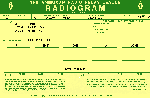
I transmitted the net name, “EAN” indicating to stations that they should now “QNI” or “check in” to the Eastern Area Net. This particular net was being conducted via Morse code, an efficient mode for this sort of work. Traffic would be heavy this Tuesday evening, just a few days before Christmas. I was Net Control Station, or “NCS” of the Eastern Area Net, a clearing house for all formal, written radiogram messages passing between regions in the Eastern Seaboard of the U.S. and Canada.
As NCS of the net it was my responsibility to act as the “master of ceremonies” to ensure that stations with messages for one region would get hooked up to their counterparts in other regions to send, receive and relay messages destined for other nets.
In response to my call, I heard:
“Dit.”
“…Dah dah.”
“… …Dididit.”
Three stations came back simultaneously with different “signs” and on slightly different frequencies a few Hertz apart. The result was a not-unpleasant melody of varying pitches spelling out letters like “E”, “M” and “S.” They were easily distinguishable to the ear. I thought I recognized the swing in the “M” emanating from the semi-automatic key “fist” of W2MTA.
“Dah dah,”I replied, pressing one side of the Bencher paddle to form the dashes indicating that the station signing “M” should go ahead.
Immediately I heard, “…DE W2MTA PAN RX QRU.“
Bill’s regular schedule, or “sked” involved him acting as the receiving station (“RX”) for message traffic destined for the Pacific Area Net. Bill used a standard Q signal, “QRU” to indicate that he had no traffic to send.
“W2MTA R AS,” I replied. “R” meant “received.” And the letters “AS” sent together “didahdididit” instructed him to standby.
“DE …”
“DE,” I replied, in turn.
“…W2EAG 1RN TX QTC CAN 12 3RN 5 4RN 3 AR.”
W2EAG, Mark in Taunton, Massachusetts was the First Region Net Transmit station. His list of traffic, or “QTC” included the traffic’s destination followed by actual number of messages. Clearly, Central Area Receive was going to be busy this evening. In addition, Mark listed traffic for the Third and Fourth Regions.
Sending radiogram traffic on Morse code can be an absolute pleasure. One of the real advantages one has using Morse code over voice is something called “full break-in.” If Mark had been transmitting simultaneously, or “doubling” with another station he would have quickly known this by hearing the dots and dashes of someone else’s signals between his own. The concept is similar to a group at a party who begin to speak all at once, then pause and allow one to proceed. Traffic handlers refer to full break-in as “QSK.” Sent as a question, QSK means, “Can you receive between my signals?” As a statement it means, “I can receive between your signals.”
“…Dididah.”
I instructed the sender of “U” to proceed.
“DE KW1U CAN RX QRU K.”
Marcia, KW1U, from Martha’s Vineyard was accepting messages on behalf of the Central Area Net. Marcia would check in directly to the Central Area Net in one hour with any messages she received off the Eastern Area Net.
I decided to get down to business.
“1U…”
“…dah,” replied Marcia, immediately.
“EAG…”
“…dit,” Mark responded, about fifty milliseconds later.
“D 10 CAN.”
Simultaneously I heard two “dahs” from Marcia and Mark, respectively, acknowledging my instructions.
In less than six seconds I had instructed both stations to move off frequency’specifically “D 10” or “down ten kilohertz.” It was understood that Marcia would be receiving traffic destined for CAN. As the receiver, she would call Mark on the closest open frequency “down ten” per my instructions.
“EAN K.” Ready for more business.
“Dahdididit.”
I acknowledged the “B” station.
“…DE VE3BDM ECN TX 1RN 4 2RN 3 4RN 6 8RN 2 AR.”
George in Elizabethtown, Ontario, acting as Eastern Canada Net’s TX station, listed his QTC.
Without so much as an “R” for acknowledgement I decided to hook George up with the Fourth Region Net Receive station–a station who had not yet checked in.
“4RN RX QNI,” I sent to the net. In other words, “Fourth Region Net Receive station please check in now.”
“…DE W4ANK 4RN RX QRU,” came the reply.
I dispatched the two off frequency:
“W4ANK VE3BDM U 7 4RN.”
I heard a quick “dit” and “dah” response from W4ANK and VE3BDM as they headed “Up Seven” to handle the Fourth Region traffic.
Ten minutes later, I had Transmit and Receive stations checked in from the First, Second, Third, Fourth, Eighth and Eastern Canada Region Nets. I also had TX and RX stations from the Central and Pacific Area Nets. The latter were members of the TCC or “Transcontinental Corps”, an elite group who liaise between the three Area nets.
An Alternate Transmit, or “ALT TX” station from First Region Net came to EAN. The 1RN Net Control Station had wisely decided to spread the load of outgoing traffic between two stations instead of a single TX station. To further assist with the heavy volume I also had 2RN- and a 3RN ALT RX stations standing by if needed. One other station with no assignment casually checked in, “QRU.” I politely excused him from the net.
I consulted the “bingo sheet,” my low-tech, pencil-and-paper solution for tracking the locations and traffic lists of all stations on the Net. By my calculations I had facilitated the passing of roughly 60 percent of the traffic listed. Several stations were “queued” up off frequency awaiting their turn to send traffic to receiving stations.
Using my auxiliary VFO, I tuned down 20 kHz to hear how the Fourth Region Net Receive and Third Region Transmit stations were doing. Everything sounded copasetic.
“…AR 1.”
“Dit.”
The 3RN TX ended a message with the pro sign “AR” followed by the number 1, indicating that he had one more message left to transmit. 4RN RX acknowledged that he was ready to copy the next message by answering with a single “dit”. I decided that it was time to have the next station with 4RN traffic queued up and ready to go.
I flipped back to the net frequency.
“HRI,” I sent, addressing the 1RN Alternate TX, WB1HRI.
“Dit,” replied WB1HRI.
“QNQ D 20 W4ANK 4RN,” I said. (Translation: “Change frequency down 20 kHz and wait for W4ANK to finish handling traffic. Then send him traffic for 4RN.”)
“G,” he replied. (“Going.”)
Just like that, it was done.
I dialed “Up 20” to listen to the traffic flow between the 2RN TX and 3RN RX stations. Things were a little rough. The Receive station had instructed the Transmit station to “QRS 10” or “Send more slowly, 10 words per minute.” There was a significant amount of signal fading, or “QSB” between the two stations.
Solid copy is paramount when handling radiograms; speed takes a back seat to accuracy. I’ve heard veteran traffic handlers slow down to less than five wpm when the situation warranted.
“…MERRY CHRI […] MA…”
“…Daaaahhhhhh….”
The receiving station hit his key to interrupt. When he heard the TX station had stopped, RX sent, “AA MERRY.” Translation: “ALL AFTER the word MERRY.”
A causal operator might assume that the word in question was CHRISTMAS. When handling traffic, however, one does not assume. Instead, one requests a “fill” by using pro signs such as AA (“All After”), AB (“All Before”), BN (“BetweeN”) and so forth.
The sending station picked up with the word MERRY and continued sending the rest of the message slowly.
Back on the Net frequency I heard, “QRL?” A station that was not a part of the Net was inquiring, “Is the frequency in use?”
“QRL” I replied. (“The frequency is in use.”)
“SRI.” The station apologized for the intrusion and left.
A moment later, I heard: “OKN NG” followed immediately by, “…FTX.”
The previous exchange between the 3RN RX and 2RN TX stations had gone poorly. W3OKN had indicated a busted exchange by saying “NG”, or “No Go.” Following proper procedure, they returned to net frequency to await further instructions. It was time to get them a relay–someone located in a favorable QTH who could both hear and be heard by them.
“OKN FTX AS,” I replied. “Standby.” Then I called for a relay.
“W4ABC.”
“Dah.” W4ABC responded.
I said, “QNB W3OKN N4FTX U 20.”
I heard three “dits” confirming that all three stations acknowledged my instructions for W4ABC to act as a relay for W3OKN and N4FTX. All three went up 20 kHz to try again.
Things were rolling along. The net had been in session for thirty five minutes. Everyone who had their traffic cleared had been “QNX” or excused from the net. Eight stations were currently passing traffic, or queued up waiting. I had had no new check-ins for ten minutes. I decided to officially close the net.
“QNC QRU EAN QNF TU GUD WRK ALL.” Translation: “Announcement. No traffic for Eastern Area Net. The Net is Free. Thank You. Good Work, Everyone.”
I remained on frequency for the next 15-20 minutes, excusing returning stations and thanking them individually. In the space of 55 or so minutes, we had collectively relayed 67 messages with 100 percent accuracy. Tomorrow evening a whole different group of Amateur operators would get together and do it all over again, as it’s done every day of the week, 365 days per year.
 A new traffic handling training net will begin on Thursday evenings at 8 p.m., beginning February 13th, on the Falmouth repeater (146.655, no tone).
 Mark your calendars for the 2nd New England QSO Party, May 3-4, 2003.
 The Worcester Polytechnic Institute Wireless Association is offering a Ham Radio class to help you prepare for the examination to earn your beginner-level Ham Radio license. Join us and learn what Amateur Radio is all about!