Cape Cod ARES Summer Exercise – Saturday 8/10/19 1000 AM-1200 PM

Rob Macedo-KD1CY writes:
Cape Cod ARES will conduct their summer exercise on Saturday August 10th, 2019 from 1000 AM-1200 PM. The exercise will be led by Cape Cod ARES District Emergency Coordinator, WQ1O-Frank O’Laughlin. All are welcome to participate. The Cape Cod ARES Exercise document can be seen at the following link:

Cape Cod ARES August 10th 2019 Exercise Plan

New Hampshire Tower Tragedy: Lessons Learned

Mark Pride, K1RX, writes on the YCCC Reflector:

To all Tower owners in the Amateur Radio Community – a must read!  By Mark Pride, K1RX

Many old timers in the hobby that own a tower, perhaps in the air for 20, 30, 40 or 50 years, need to take this article seriously as it could provide life saving information to you and your ground crew. This is a cautionary article for all that have a tower no matter how long its been the air.  What occurred at a NH amateur station recently provides a lesson for all of us tower owners. Although the article speaks to a Rohn 25 guyed tower product, it could be prove helpful to others.

K1JGA and K1EEE tower tragedy

A crew of amateurs gathered at the home of K1EEE to take down two 40 ft. Rohn 25 towers.  The details of the tower which collapsed and its failure is provided below.  It was a very unfortunate accident which took the life of Joe G. Areyzaga, K1JGA.  The owner of the tower, K1EEE suffered multiple injuries but did survive.  We all in the amateur radio community extend our prayers and condolences to the families affected by this tragic event.

Tower Description

One of two forty foot (40 ft.) Rohn 25 towers, with one set of guys at the 35 ft level was to be taken down. The base was the BPH 25 hinge plate on a concrete pad of unknown depth. This used tower had only been up 3 years. 

NOTE:  Following the accident, the owner learned one leg of the hinge plate had been previously repaired but the material used was not galvanized.

With the reasonable expectation the tower would support itself to 40 ft, the guy wires were disconnected from the anchors and the top section was to be removed. The top section to be removed had a rotor shelf and one torque assembly mounted at the 35 ft. level along with the three guy wires. The gin pole had not been raised at that point.  The antenna, mast and rotor were previously removed.

Lesson Learned

At the time of the initial install, the tower was self supported to 40 ft until the first set of guys were attached per Rohn specifications. That may have been the case then, but after many years of exposure to the elements, one can no longer expect the same! 

Prior to the start of the tower take down, the tower was thoroughly inspected and found to be in acceptable condition.  The base was dry and free of any water. No obvious problems were found.

The general reason for this tower collapse was corrosion at the junction of the hinged base short legs (one leg previously repaired and welded as noted above) and the bottom of the lowest Rohn 25 section occurred primarily from the outside and some inside as well and thus weakened the structure. The first point of failure was the repaired and non-galvanized short leg of the hinge plate. When the guys were removed from their anchor points (necessary to remove the top section), the tower was free standing with the two climbers at 35 ft.  It’s clear that the tower deflection from the vertical was extreme enough to make the overturning force at the base (the bending moment) great enough to cause base failure. 

The proper installation of the hinge bracket (BPH 25) requires mounting it on a flat concrete surface, secured with bolts placed in the concrete, surrounded by a beveled edge for water run off.  Normally, all of the hardware associated with the hinge plate are galvanized and able to withstand the wear and tear of Mother nature.  However this base was slightly recessed where the plate sat and there were some gaps under the plate. This created the opportunity for water or ground contaminants to collect. It is presumed the previously repaired short stubby leg of the bracket began to corrode while sitting in water. Years of this kind of exposure slowly weakened the metal.  Subsequent movement by climbers at the top of the unguyed tower led to breakage at the base. 

NOTE:  Rohn towers are very high quality and generally last many, many years with proper installation and maintenance.  It is a very popular tower in the amateur radio community. And where tower sections join, they typically show little wear as water drainage occurs easily and there is a limited chance for collecting contaminants and held for long periods of time.  Or where tower materials come in contact with the earth, the normal galvanizing process is more than adequate for a long lifetime. But what is noted here is areas that are in contact with the ground or areas such as the repaired leg of the bracket that can accumulate harmful materials and therefore become a danger over time.  Clearly there are areas on a tower that are difficult to inspect however, the Rohn design usually lends itself to high levels of confidence that these blind areas are within acceptable standards if installed per the manufacturers specifications.

JGA Safety Guy Technique for Tower Take Downs in honor Joseph G. Areyzaga,  K1JGA (SK)

When dealing with unknown tower installations that require removal, it is absolutely critical to err on the side of extreme caution.  The technique described below is one approach and a simple one to help safe guard all involved.

A suggested safety procedure that should be applied during any tower take down of this type is attaching a set of additional guy wires at either the 10 or 20 ft. level prior to any work on the tower.  By applying a set of guys near the base, further stabilization of the tower base can be achieved.  Using this added set of guy wires reduce stress on the legs (twisting, flexing, bending) and prevent breakage at the very bottom of the section just above the concrete surface or surrounding areas.  Then what would remain after the tower is taken down to the Safety Guy set becomes very manageable (10 or 20 ft. to be lowered to the ground).

And in honor of our friend and now silent key, Joe, K1JGA, I am naming this important safety procedure the “JGA Safety Guy Technique” with the hopes all of us will not forget Joe but more importantly, keep us all safe while our old towers are taken down.  In particular, towers that have been up for our entire ham career and its maintenance history may be questionable require special attention.  Of course if the base shows significant deterioration, corrosion and breakage, the tower should NOT be climbed!  It should be removed by other means (cut down if the landing area is open and clear or by crane or similar).

The suggested collection of material that comprises the JGA Safety Guy Technique include:

Three (3) lengths of unbroken or spliced guy wire (3/16 inch EHS or larger) longer than the lowest guy to be sure it is long enough (DO NOT USE ROPE!);

Guy Grips for each end of the guy wire;

A come along at each guy anchor point for proper tensioning and;

A reliable heavy duty attachment device to connect to the existing anchor.

The attachment to the guy anchors should be done in a way that does not interfere with the existing guy anchor assembly (turnbuckles, etc.).  If the JGA Safety Guy kit is to be used in multiple tower take downs of varying heights, use of the Guy Grips will allow full flexibility of locating the attach points where they are needed, without cutting cable.  Just make the cable length longer than you might need to give you enough head room.  One further consideration: Rather than just use this technique near the ground, consider always using it no less than 10 ft. below where you may be working I.E. erecting or dismantling a tower, place the JGA kit 10 ft. below the location you are either installing or removing the next section.  Therefore, the guy lengths need to be approximately the same length as the longest guy (upper guy). This will assure maximum safety. With the guy grips, it is easy to relocate them, as you adjust the length of the temporary guy at each point on the tower.

 As part of your annual maintenance plan, include keeping the base free of debris, dirt, trees, plants etc. to protect this area from any long term damage. Consider making one of these JGA Safety Guy kits for your club to be used as necessary. 

Best to use the JGA Safety Guy Technique and find the tower base was just fine, than not use it and suffer a similar situation or worse!  Stay safe!
Eastern Massachusetts Hospital Net – Saturday August 3rd, 2019 – 1000 AM EDT

Good evening,

Since we do not have a Net Control Volunteer for the upcoming August Net, the South Shore Health Amateur Radio Group – W1SSH will once again act as Net Control.

The net will commence at the usual time of 10:00 AM using the following repeaters and simplex frequency in the order listed.

Please note: The simplex frequency for this month’s net has changed. Because we will be using the frequency in simplex mode, without tone, if it is not already programmed into your radio, the frequency can easily be entered into your radios “VFO” channel without the need for regular channel programming.

1. Sharon 146.865 tone 103.5
2. Bridgewater 147.180 tone 67.0
3. Norwood 147.210 tone 100.00
4. Simplex 146.580 MHz

The Net will then return to the Sharon Repeater for any final comments and Net closing.

NET Protocol: Please wait for Net Control to ask for Check-ins. When asked to check in please use the standard net check-in procedure which is: Here is.., un-key, wait 3 seconds to check for doubling, then give your or your facilities call sign, your first name, and your facility’s name.

We extend an invitation to any health care facility or EOC of any city or town that is served by one of the participating hospitals to join the Net. We also extend an invitation to any RACES or ARES member to check in during the NET.

We are always seeking groups or organizations to try their hand at Net Control duties. If you are interested in joining the group please let us know. We can be reached by sending an email to ssharg@outlook.com. The goal is to rotate Net Control practice and the experience among as many individuals and groups as possible.

We thank the repeater trustees for their generosity in allowing us to conduct the monthly nets and the use of their systems in an actual event. The following list of repeaters is available for our use. Only a few systems are used each month with the selection of those used made by Net Control for that month. More systems are being added to the list on a regular basis.

Repeaters
Attleboro 147.195 tone 127.3 (Sturdy Memorial Hospital)
Belmont 145.430 tone 146.2
Boston 145.230 tone encode 88.5 tone decode 100.0
Bridgewater 147.180 tone 67.0
Danvers 145.47 tone 136.5
Dartmouth 147.000 tone 67.0
Fall River 146.805. tone 67.0
Falmouth 147.375 tone 110.9
Mansfield EMA 446.925 tone 100.0
Mansfield 147.015 tone 67.0
Marshfield 145.390 tone 67.0
Norwood 147.210 tone 100.00
Plymouth 146.685 tone 131.8
Salem 146.88 tone 118.8
Sharon 146.865 tone 103.5
Weymouth 147.345 tone 110.9 (South Shore Hospital)
W. Bridgewater 146.775 dcs 244
Wrentham 147.09 tone 146.2

We look forward to hearing you all on the Net.

Respectfully,

John O’Neill – K1JRO
President – SSHARG
ARES – DEC – Hospital Liaison

South Shore Health Amateur Radio Group – W1SSH
55 Fogg Road, Box 42
South Weymouth, MA 02190

Annual Marshfield Fair Amateur Radio Exhibit, August 16-25, 2019

Whitman ARC logoThe Whitman Amateur Radio Club will sponsor a ham radio exhibit and special events station at the 152st Annual Marshfield Fair August 16-25,  2019, from 1600Z-0059Z. The club will operate under the call sign NN1MF on the following frequencies/bands: 18.160, 14.260, 7.260, and 3.860 MHz. The station will also be active on EchoLink via the WA1NPO-R, and IRLP: 8691. Contacts will be acknowledged with a certificate and QSL at: Whitman ARC, PO Box 48, Whitman, MA 02382. 

W1HFN Fox On the Air, Littleton, July 25, 2019

Barry Fox, W1HFN, writes on the foxhunting list at 11:52 AM on July 25, 2019:

Since the WX is not so HHH lately, I deployed the fox at the Whitetail Woods in Littleton.

The battery pack should last until at least next Thursday, so the weekend should be fine for hunting.

https://littletonconservationtrust.org/tws_holding/white-tail-woods/ 

Frequency is 146.565 MHz with a 20 second voice ID every 40 seconds.  Sign the log which is under the TX. 

Good luck / 73,

Barry – W1HFN

Eastern MA Hospital Net, August 3, 2019

John O’Neill, K1JRO writes:

Good Morning Everyone,

The August 3, 2019 Eastern MA Hospital Net is approaching. We do not have anyone signed up to conduct the August net.

If anyone is interested in taking a turn as Net Control Station please let us know. 

Below are the repeaters we have available for our use. Let us know which 3 or 4 repeaters you would like to use and we will make all the notifications. We will also send you a copy of our net preamble if you like which you may modify for your own use. 

73’s,

John  O’- K1JRO

Attleboro 147.195 tone 127.3 (Sturdy Memorial Hospital)
Belmont 145.430 tone 67.0
Bridgewater 147.180 tone 67.0
Danvers 145.47 tone 136.5
Dartmouth 147.000 tone 67.0  
Fairhaven 145.490 tone 67.0    
Fall River 146.805. tone 67.0
Falmouth 147.375 tone 110.9
Mansfield EMA  446.925 tone 100.0
Mansfield 147.015 tone 67.0
Marshfield 145.390 tone 67.0      
Norwood 147.210 tone 100.00
Plymouth 146.685 tone 82.5
Salem 146.88 tone 118.8        
Sharon 146.865 tone 103.5    
Weymouth 147.345 tone 110.9 (South Shore Hospital)
W. Bridgewater 146.775 dpl 244 
Wrentham 147.09 tone 146.2


South Shore Health Amateur Radio Group – W1SSH

55 Fogg Road, Box 42

South Weymouth, MA 02190

QSL Sorting Night at Algonquin ARC, August 8, 2019

Eric Williams, KV1J, W1 QSL Bureau Co-Manager writes:

Seventh Annual AARC QSL Sort Night 

The Algonquin Amateur Radio Club will be holding a QSL card sorting session on  Thursday, August 8, 2019 at 7:30 PM at the Marlborough Fire Station.  We will  be in the classroom/EOC where we hold Field Day. 

The W1 QSL Bureau receives QSL cards from DXers all over the world, sorts them and then  sends them to the New England area hams.  We process about 100,000 QSL cards each year.  To do this, we are grateful for the team of over 40 volunteers and several area clubs that help make this happen.  AARC is one of the clubs that helps with the presorting step in our process. 

Our part is easy and fun.  You get to see QSL cards from all around the  globe.  Maybe catch a card that is for you!  We will have boxes of cards from the country national organizations that are for W1 call area hams.  For our session we will have about 13,000 cards. Our mission is to sort  those cards into stacks for each first letter of the call sign suffix.  So there will be a stack for all the call signs the a suffix the starts  with A and one for those starting with B and so forth.  It goes quick especially with lots of people doing it on several separate tables. 

When we are done, those stacks will be sent to our individual letter sorters who will then sort them by the individual recipient hams. 

Thank you and hope to see you next month. 

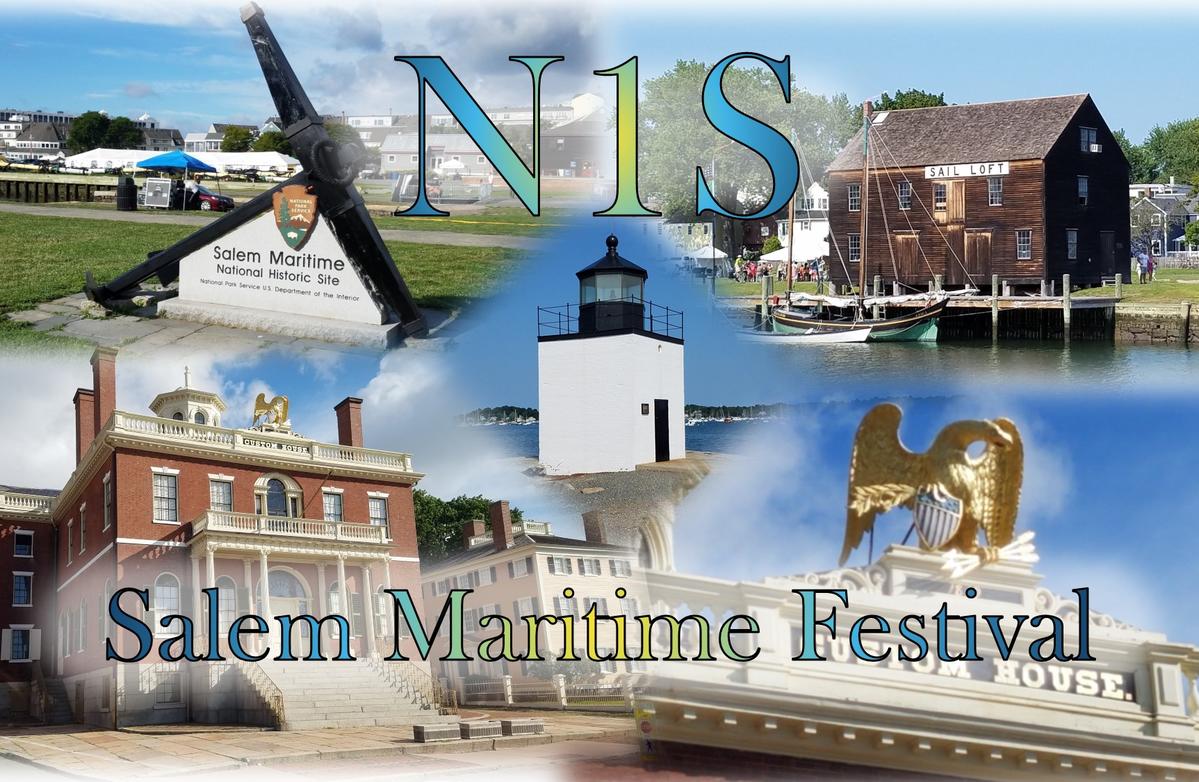
Salem Maritime Festival Special Event Station N1S QRV, August 3-4, 2019

Nick Mollo, KC1DKY, writes on QRZ.com:

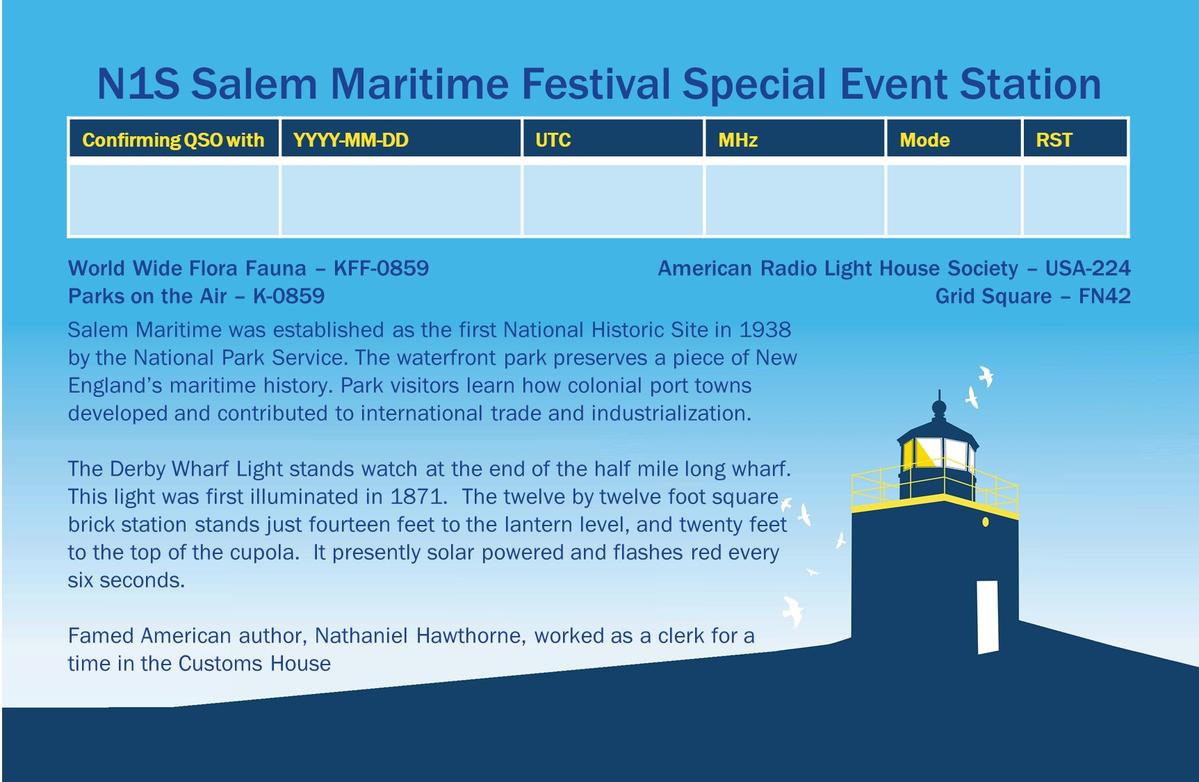
N1S will be the call sign used at National (Park) 1 Salem (Maritime) to celebrate their 31th annual Salem Maritime Festival being held on Saturday and Sunday, August 3rd and 4th, 2019.  The Parks On The Air team will predominantly transmit on 20m and 40m.  Operations on SSB, CW, and FT8 are assured, with PSK as a possibility.  Efforts to make satellite contacts on SO-50, AO-85, AO-91, and AO-92 will be made as well.  Watch the spotting clusters to find out where we are currently transmitting.  We will be on the air starting around 13:00UTC (9am Eastern) until around 20:00UTC on both days.

This is the fourth year the team will be transmitting from the event.  We will be multi-operators, on two stations – one 100W for HF and one 50W for satellites.  We will be highlighting amateur radio for all of the park visitors attending the festival using a laptop with a large screen monitor, plenty of table space, a practice oscillator for Morse code, and plenty of handouts.  We want to get as many visitors on the air as well, so if you make contact with us and we give you a solid “5×9” report, please stand by your radio and help us put a smile on a young child’s face by being the station on the other end.

Stations will receive credit for the following programs:
WWFF / KFF – Park designator KFF-0859
Parks on the Air designator K-0859
ARLHS designator for Derby Wharf Light House – USA-224

QSL cards to commemorate the special event station and the festival will be available for $1 + SASE for US contacts and $3US and self-addressed envelope for international contacts.  Visit my QRZ page, KC1DKY, as the event draws near for additional QSL information.  The cards will be nice to add to your collection.  So listen for us, and make a contact!

Eastern MA Hospital Net – July 6, 2019

Hi Everyone,

Net Control for the July 6, 2019 Eastern MA Hospital Net will be W1SSH, The South Shore Health Amateur Radio Group. The net will commence at the usual time of 10:00 AM using the following repeaters in the order listed.

1. Plymouth 146.685 tone 131.8
2. W. Bridgewater 146.775 dcs 244
3. Sharon 146.865 tone 103.5
4. Simplex 147.42 MHz

The Net will then return to the Plymouth Repeater for final comments and Net closing.

NET Protocol: Please wait for Net Control to ask for Check-ins. When asked to check in please use the standard net check-in procedure which is: Here is.., un-key, wait 3 seconds to check for doubling, then give your or your facilities call sign, your first name, and your facility’s name.

We extend an invitation to any health care facility or EOC of any city or town that is served by one of the participating hospitals to join the Net. We also extend an invitation to any RACES or ARES member to check in during the NET.

We are always looking for groups or organizations to try their hand at Net Control duties. If you are interested in joining the group please let us know. We can be reached by sending an email to ssharg@outlook.com. The goal is to rotate Net Control practice and the experience among as many individuals and groups as possible.

We thank the repeater trustees for their generosity in allowing us to conduct the monthly nets and the use of their systems in an actual event. The following list of repeaters is available for our use. Only a few systems are used each month with the selection of those used made by Net Control for that month. More systems are being added to the list on a regular basis.

Repeaters
Attleboro 147.195 tone 127.3 (Sturdy Memorial Hospital)
Belmont 145.430 tone 146.2
Boston 145.230 tone encode 88.5 tone decode 100.0
Bridgewater 147.180 tone 67.0
Danvers 145.47 tone 136.5
Dartmouth 147.000 tone 67.0
Fall River 146.805. tone 67.0
Falmouth 147.375 tone 110.9
Mansfield EMA 446.925 tone 100.0
Mansfield 147.015 tone 67.0
Marshfield 145.390 tone 67.0
Norwood 147.210 tone 100.00
Plymouth 146.685 tone 131.8
Salem 146.88 tone 118.8
Sharon 146.865 tone 103.5
Weymouth 147.345 tone 110.9 (South Shore Hospital)
W. Bridgewater 146.775 dcs 244
Wrentham 147.09 tone 146.2

We look forward to hearing from you all on the Net.

Respectfully,

John Barbuto
KS1Q

South Shore Health Amateur Radio Group
55 Fogg Rd. Mail-Stop 42
South Weymouth, MA 02190

W1UE to Activate VY1AAA for Canada Day, July 1, 2019

Dennis Eagan, W1UE, writes:

I have the honor of operating VY1AAA [remote] for the Canada Day contest this year. Operation will be low power CW only.  Still, it may be the only way you’ll get to work YT if you want it!

I don’t expect much propagation on 15 or 10m, but you never know.  Should be on the 4 lowest bands.  I’m figuring on 12-16 hours of operation, depending on rate and my ability to stay awake!

-Dennis VE3WUE, W1UE, VY1AAA

KC1DKY Fox Hiding Out in Billerica, June 28, 2019

Nick Bollo, KC1DKY, writes on the foxhunting list at 1:27 PM on June 28, 2019:

It has been a while, but finally, the KC1DKY fox is out and hiding on Billerica town land.  Fox is on 146.565MHz.  Send a DTMF of 1 to activate the fox.  If the fox does not seem to be responding, send a couple DTMF # and then a 1 to possibly whack it back into shape.  The fox will signal for 30seconds and be silent for 15sec, and repeat for 15minutes.  The fox is located around a third of a mile from the parking area and about 50ft or so in from the trail, no bush whacking but watch out for tree limbs.  Don’t forget to sign the log book in the plastic bag next to the fox.  I recommend some bug spray.

Good luck and have fun!

*****SPOILER*****

ACIRELLIB NI KRAP SNARETEV MANTEIV NI DETACOL SI XOF EHT

W1HFN Fox Deployed, Littleton, June 27, 2019

Barry Fox, W1HFN, writes on the foxhunters list at 1:09 PM on June 27, 2019:

I deployed the W1HFN fox today in the Mill Hill conservation land off Mill Road in Littleton.  Frequency is 146.565 with a voice ID every 30 seconds.

https://littletonconservationtrust.org/tws_holding/mill-hill/

When I recovered it last time, the TX was keying up for 2 seconds then shutting down.  I assumed a dead battery.  When I got it home and recharged the battery, same symptoms.  Wrong assumption.  Turns out water had leaked into the case and landed on the TX PC board.  It reacted with something and left a conductive goo all over the traces.  Scrubbed it off with alcohol and toothbrush, then dried with a hair dryer.  Worked OK, but had lost its audio message.  

Reprogrammed the audio and we’re off to the races.

Happy Hunting.

Boston ARC Field Day at Bare Cove Fire Museum, Hingham, June 22-23, 2019

Boston ARC logoJoe Chapman, NV1W, writes in the June issue of BARC’s The Sparc:

Field Day is less than two weeks away, on June 22 and 23, and as usual, [the Boston Amateur Radio Club] will be operating from the Bare Cove Fire Museum in Hingham. This is a high point of the year for me and for many other BARC members as well. If you’ve never been to Field Day before, consider joining us on Saturday, Sunday, or both. At the very least, consider coming for the cookout on Saturday.

We’ll start setting up on Saturday morning, and in addition to helping out, you’ll also learn a lot about setting up a station and erecting temporary antennas. It’s always fun to see what equipment others bring, and if you avoid buying ham equipment in the weeks after Field Day you have more self-control than I do.

Operating starts at 14:00 on Saturday. There will be plenty of Extra class licensees available to pair up with Technicians who want to try out HF. You may want to learn about a new mode like PSK31, or just watch experienced operators work. Even old dogs will find plenty of new tricks to learn.

I hope at long last to demonstrate a successful satellite contact. The SSB/CW satellite FO-29 will have a nice high pass starting at 16:40 on Saturday afternoon that looks perfect. To quote Bullwinkle J. Moose, this time for sure!

Fresh Air, Outdoor Fun: Crow Island ARA; Field Day Operation Planned

Ed Fitzgerald, K1DIN, writes on the Algonquin ARA list:

Ron Lahti, N1CNG, will be inviting interested hams to enjoy some fresh air radio fun at Crow Island, a beautiful private island airport surrounded by the Assabet river in Stow. The Airport presently hosts a few organizations such as a flying club, a model airplane club, and a trapeze training group, each assigned to segments of the island. The Crow Island owner has given Ron, a member of the model airplane club, permission to use a selected area for Ham Radio and Emergency Management radio activities. With help of some interested hams, Ron has been putting together the organization, planning the management, and purchasing site equipment, such as a tent, generator, lights, antennas, and military type guyed poles.

As you might imagine, Crow, as a privately-owned entity hosting organizations with various safety concerns, must insist on observance of some reasonable regulations and keyed access to the property. The rules simply keep the place workable, fun, and safe for all the groups. The simple procedures and regulations will be on the website.

Our choices of activities may include contesting (even all night – porta potty on site), testing equipment, experimenting, MEMA exercises, and, on the less technical side, barbecuing, enjoying the clear spring water (hand pump), swimming in the island pond (no life guards), and simply being outside in an amazing New England setting.

Ron is developing a website which should be up within a few days. We will announce the website availability here in the AARClist email.

Ron plans to be at Project Night and will take questions.

[Ed. note: the Crow Island QTH has been registered on the ARRL Locator page as the site of a proposed Field Day operation.]

W1HFN Fox Deployed in Littleton, June 8, 2019

Barry Fox, W1HFN, writes on the foxhunting list on June 8, 2019 at 1:16 PM:

Freq 146.565 with a 20 second voice ID every 40 seconds.  Location is Prouty Woods off Foster Street in Littleton, behind the fire station.  Battery should last a week or so.

https://littletonconservationtrust.org/wp-content/uploads/2016/07/proutywoods.jpg 

Some bushwhacking involved, but not too much.

Happy hunting.

80 Meter Fox in Westford, June 1, 2019

Andy Stewart, KB1OIQ, writes on the foxhunting list on June 1 at 12:14 PM:

There is an 80m fox  deployed in Cider Mill Pond in Westford.  Note that this conservation area is  now 55 acres bigger due to a recent purchase by the Town of Westford.

It is designed to automatically turn on around 8 AM, and automatically turn off  around 7 PM.  It should actually transmit a “QRT” message as it goes down.  If  you hear it transmitting a “LOW POWER” message, let me know, as that means the  battery is nearly depleted.

I’m curious to see how long the battery lasts with my latest improvements.

Frequency: 3579-3580ish.

WX4NHC Annual On-The Air Station Test – Saturday June 1st, 2019 – 900 AM-500 PM EDT (1300-2100z)

Hello to all…

Please see the following information from WD4R-Julio Ripoll, Assistant WX4NHC Coordinator on the 2019 WX4NHC On-Air Communications Test which will be held this Saturday June 1st, 2019 from 9 AM-5 PM EDT (1300-2100 UTC) across various bands and modes on Amateur Radio. We encourage Amateur Radio Operators in our region to participate. See link below:

Special Announcement: WX4NHC Annual On-The Air Station Test – Saturday June 1st, 2019 – 900 AM-500 PM EDT (1300-2100z)

Respectfully Submitted,

Robert Macedo (KD1CY)
ARES SKYWARN Coordinator
Eastern Massachusetts ARES Section Emergency Coordinator
Home Phone #: (508) 994-1875 (After 6 PM)
Home/Data #: (508) 997-4503 (After 6 PM)
Work Phone #: 508-346-2929 (8 AM-5 PM)
Email Address: rmacedo@rcn.com
http://ares.ema.arrl.org
http://www.wx1box.org
Like us on Facebook – http://www.facebook.com/wx1box
Follow us on Twitter – http://twitter.com/wx1box

Seeking Ops for 13 Colonies Special Event Station K2H, July 1-7, 2019

Bob Kelley, K1KVV writes on the Southeastern MA ARA web site:

I’m seeking operators for K2H, the shared Special Event callsign for all Massachusetts.

Please let all members of our club know about this opportunity. I can add both W1AEC and home station operators to the official 13 Colonies K2H operators list.

Do you want to have the experience of being called instead of calling to make a contact? You’ll get calls from both domestic and DX operators who want to qualify for the certificate endorsements. As an operator of K2H, you will automatically qualify for a certificate. You can also contact the other 13 Colonies S/E stations to earn your own endorsements.

You’d be surprised at how many contacts you can make with a simple wire antenna. You can work as many or few hours as you wish during the week. Each operator is self-scheduled by using an on-line calendar to reserve Band, Mode, and Hour blocks of air time. Also, at the end of the week, each operator submits their own Cabrillo logs to the Massachusetts QSO / QSL coordinator, Joe Casieri, KA1JBE and QSO totals to Ken Villone-KU2US, event organizer.

More details will be available shortly. Meanwhile, go to 13colonies.net for more info. There you can then click on Massachusetts / K2H for other details. [This information will be augmented shortly.]

This event is NOT a contest; so 12m, 17m and 30m bands may be used.

Contact me if you would like to participate and/or if you need more information, etc.

— 73 de Bob K1KVV

Local Area Activity for Museum Ships Weekend, June 1-2, 2019

The USS Cassin Young, WW2DD, will be among the museum ship stations on the air for Museum Ships Weekend. Mike Rioux, W1USN, and Bob Reiser, AA1M, will activate the famous Fletcher-class destroyer, DD-793. According to Wikipedia, the Cassin Young served as a part of the Fast Carrier Task Force. On April 28, 1944, this force sortied for air attacks on Japanese strongholds at Truk, Woleai, Satawan, and Ponape, during which Cassin Young operated as a picket ship, assigned to warn her group of possible enemy counterattack. The ship is on permanent loan to the National Park Service. She is berthed at the Boston Navy Yard, part of the Boston National Historical Park in Charlestown.

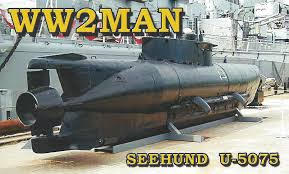
Henry Brown, K1WCC, plans to activate the German Seehund Midget Submarine U-5075 as WW2MAN. According to its QRZ page, the Seehund is located at the United States Naval Shipbuilding Museum Massachusetts Military Research Center in Quincy. Seehund means “seal.”  It was the most successful of several German attempts to perfect a midget submarine. Operated by two men and carrying two underslung torpedoes, the Seehund was used very effectively in the waning months of World War II, sinking over 120,000 tons of allied shipping. 

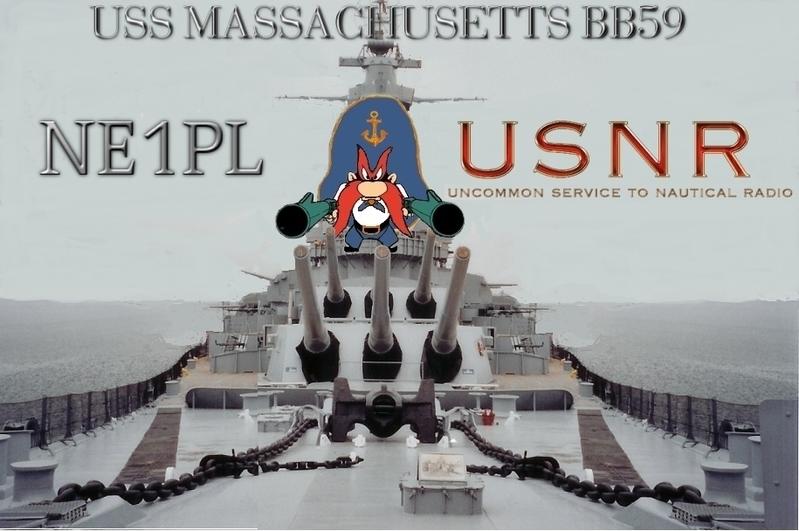
Rick Emord, KB1TEE and crew will be activating the USS Massachusetts from Battleship Cove in Fall River using the callsign NE1PL.  The USS Massachusetts (BB-59), known as “Big Mamie” to her crew members during World War II, was a battleship of the second South Dakota class. She was the seventh ship of the United States Navy to be named in honor of the sixth state, and one of two ships of her class (along with her sister Alabama) to be donated for use as a museum ship. Massachusetts has the distinction of having fired the US Navy’s first and last 16-inch (406 mm) shells of the war.

Watch for all of these ships on the Cluster.

USS Cassin Young/ WW2DD


NE1PL QSL card