Newly-Formed Hudson High School ARC Flourishes Under Teacher’s Guidance

From QRZ.com, W1HUD:

Founded in April of 2019, the Hudson High School Ham Radio Club went on the air with a new club station license as KC1LFV.  Within a few weeks, the FCC issued our new club vanity callsign: W1HUD.

Hudson High School is a public school enrolling about 950 students in grades 8 – 12.  It is located in the New England town of Hudson, MA, about 27 miles (43 km) west of Boston.  We offer a broad general education curriculum, including about 155 elective courses to meet widely varying student interests.  Included among these are courses in digital electronics, robotics, and an advanced AP Physics course in calculus-based electricity and magnetism.

Unlike in years past, most teens today have never even heard of amateur radio, let alone seen a ham station in operation. The HHS Ham Radio Club was formed to address this gap in knowledge, and hopefully to inspire young people to become interested in amateur radio.  

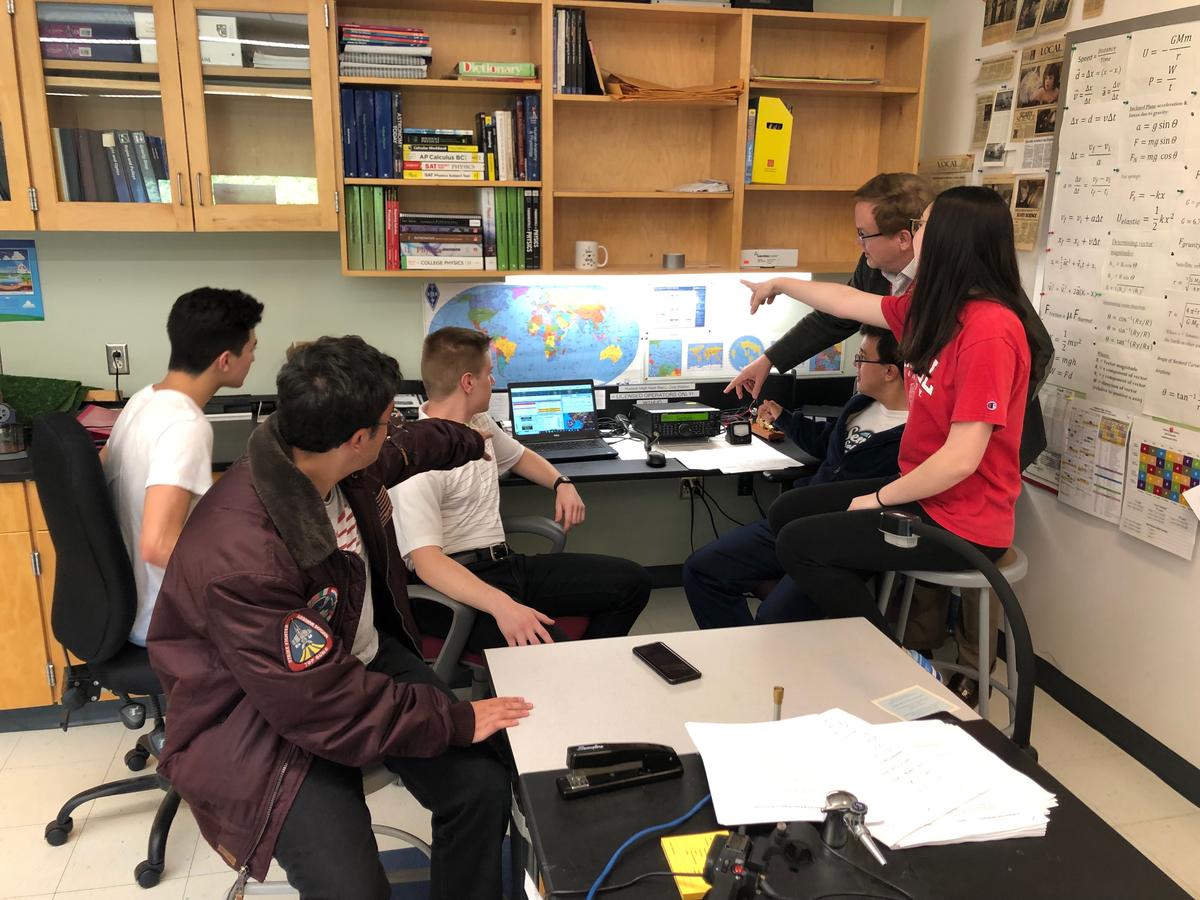
The first “shack” for W1HUD is located right inside the Honors and AP Physics classroom/lab at the high school, where students can try their hand at listening and operating under the close supervision and operational control of the club’s founding trustee Reed Prior (W1TF), who is a physics and astronomy teacher at the school.

The club currently is using a borrowed Kenwood TS-590S transceiver feeding a donated 18 ft tall Hy-Gain 5-band vertical antenna mounted on the building roof.  The roof is made of membrane coated steel, so it provides an excellent counterpoise.

Most operations since inception have been on FT-8 digital using WSJT-X software running on a loaned teacher’s laptop.  Operating in digital mode has proved especially appealing to the students in our situation, since:

  1)  Digital operations are “quiet in the shack” (with the burbling tones turned down on the AF control), so students and the controlling operator can operate the station while other classes are running in the same room.

  2)  Young people these days are . . . well . . . shy about speaking live with strangers.  They’ve grown up in an SMS texting world, where even dating is often done as much by texting each other as by interacting in person!  They seem naturally fascinated by the power of digital communications sans the internet infrastructure.

  3)  With the club’s modest “Little Pistol” station of just 100 watts feeding an omnidirectional vertical antenna, students are amazed by the range of DX stations they can reach this way, even during the day.  Strong signal reports from 10,000 miles away in Australia come to us on 40m and 30m almost every morning.  

New England Sci-Tech, STARS Exhibit at AMS Annual Meeting, Boston, January 12, 2020

New England Sci Tech logoNew England Sci-Tech (NEST) / Sci-Tech Amateur Radio Society (STARS) will staff an exhibit at the 19th Annual WeatherFest at the American Meteorological Association Annual Meeting in Boston on Sunday, January 12, 2020 from 12 noon to 4 PM, according to NEST’s Bob Phinney, K5TEC.

According to the WeatherFest web site, “We love to have hands-on, interactive experiments and booths by organizations, university, government, television, radio and private industry.  Exhibit space is free.  All you need to do is staff your booth with enthusiastic people who can capture the imagination and inspire children of all ages.”

WA3ITR: “High-Altitude Ballooning” at New England Sci-Tech, January 14, 2020

Charlie Bures is leading a new program called “Your Project in Space” for teens. Sign up soon.

From the Sci-Tech ARS Newsletter, January 1, 2020:

 
Charlie Burs, WA3ITR, will talk about high-altitude ballooning (HAB) and his HAB project at New England Sci-Tech. Any teens who are members of STARS or NEST can participate for free.
 
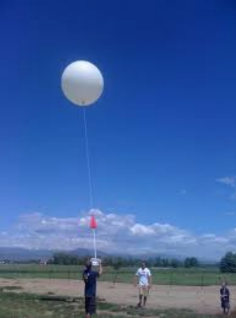
Charlie says “The goals are to get young people involved in an HAB project, which has Amateur radio (an APRS tracker device) with STEM learning. They will learn about project planning, platform testing, launching, tracking, and recovery of the balloon and its payload, and flight data analysis. The platform will carry up to 3 GoPro cameras, a commercial GPS tracker, and the APRS tracker. A 20-foot tether connects the platform to the HAB balloon, which is filled with helium or hydrogen, and is about 8 feet in diameter at launch. The platform will weigh less than four pounds.”
 
As the balloon ascends, the APRS tracker will provide location info, pressure, temperature, altitude and a few more items in its telemetry. At around 90,000 feet after a two- to three-hour ascent, the balloon will have expanded to over 30 feet in diameter when it explodes and the package starts its return to earth by parachute so the team can recover the data.

December “Youth On The Air” Month

Youth On The Air Month takes place from 0000 UTC on December 1 until 2359 UTC on December 31. Participants earn certificates by working the various YOTA-suffix stations on the air throughout December. Not a contest, the event is aimed at getting as many youngsters on air from as many countries as possible. Stations operated by young radio amateurs around the world will get on the air to celebrate youth in amateur radio. YOTA Month began a few years ago in International Amateur Radio Union (IARU) Region 1, and the concept has now taken root in the Americas as YOTA Month in the Americas.

During YOTA Month, radio amateurs aged 25 and younger will be on the air as special event stations during December on various bands and modes. In the US, look for K8Y, K8O, K8T, and K8A. Elsewhere in the Americas, VE7YOTA will be on the air from Canada. XR2YOTA in Chile has been added to the list of youth stations in the Americas for YOTA Month. Young hams in other countries may also join in. Listen for other YOTA Month stations with “YOTA” suffixes.

For more information about YOTA in the Americas, contact Coordinator Bryant Rascoll, KG5HVO, or Camp Director Neil Rapp, WB9VPG.

-From http://semara.org

Next Kids Day is Saturday, January 4, 2020

John Murphy, KB1PHN with nephew DannieFrom ARRL Web:

The first Saturday in January is Kids Day — the time to get youngsters on the air to share in the joy and fun that Amateur Radio can provide. Kids Day gets under way on Saturday, January 4, at 1800 UTC and concludes at 2359 UTC.

Sponsored by the Boring (Oregon) Amateur Radio Club, this event has a simple exchange, suitable for younger operators: First name, age, location, and favorite color. After that, the contact can be as long or as short as each participant prefers. Kids Day is the perfect opportunity to open your shack door and invite kids over to see what Amateur Radio has to offer.

Details are on the ARRL website. 

New England Sci-Tech Technician License Course, January 11-12, 2020

New England Sci Tech logoFor junior high and high school students, homeschool students, and adults interested in wireless communications and electronics, this fast-paced, two-day course will get you ready to take the Amateur Radio Technician license exam.

Topics range from the science of radio electronics to the FCC rules governing the radio spectrum. Some preliminary reading and study is necessary to get the best results from this course. Material will be sent a few days before the course.

The Technician level course runs on Saturday, 9 AM-4 PM and Sunday, 9 AM-1 PM, followed by the FCC Technician exam at 1:00, at New England Sci-Tech, 16 Tech Circle, Natick. [Full description]

New England Sci-Tech Technician Course, Five Weekdays, January 8-February 5, 2020

New England Sci Tech logoWe are pleased to offer a beginner level ham radio license course for adults, children, and child-parent pairs to facilitate their successful completion of the FCC radio license test. This course is appropriate for children ages 12 and up. Adults without children and children without adults are also welcome. Please call for logistics and permissions if any parents are unable to accompany their children for classes.

Topics range from the science of radio electronics to the FCC rules governing the radio spectrum. The FCC Technician test will be given in the final class. This course is similar to the weekend course, but it is a slower and easier pace, geared toward children and beginners, and allows people to review content in the evenings.

The class meets for 2-1/2 hours on 5 weekdays, 6:30-9:00 pm, at New England Sci-Tech, 16 Tech Circle, Natick. Doors open 30 minutes before. Included with course fee: printed handouts, lecture study guide, license fee if tested at our location, a guest pass to the  radio rooms and radio club meetings for 2 months, and free coffee, tea, or hot chocolate during the course.

If parent will not be taking the course with the child, please fill out the Child Drop-off Permissions Form after registering your child for this workshop.

For questions, reservations, and pricing options, e-mail bobphinney at nescitech.org or call 508-720-4179. https://www.nescitech.org/product/tech-in-5-days/

Local Clubs Assist Olin College Amateur Radio Club Members with Antenna Project

Olin students at New England Sci-Tech
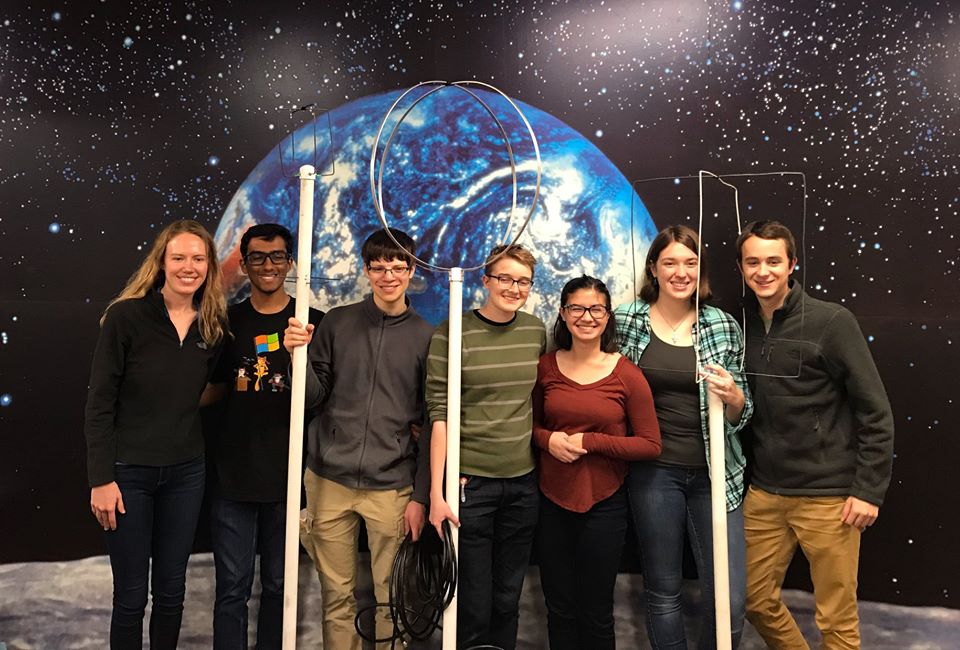
Olin College’s new amateur radio club poses “on the moon” with their newly-built antennas

From the New England Sci-Tech Facebook page:

Members of Olin College‘s new amateur radio club visited New England Sci-Tech on Tuesday night, joining members of the Framingham Amateur Radio Association, Wellesley Amateur Radio Society and host group, Sci-Tech Amateur Radio Society (STARS), in a casual meet and greet. STARS members Nolan Palmer, KC1IEO, and Mindy Hull, KM1NDY, assisted the Olin students in testing their antennas out in the parking lot. We look forward to collaborating with all these fine clubs!

Wellesley ARS/New England Sci-Tech Collaboration: High Altitude Balloon Project

Charlie Bures, WA3ITR, writes in the Wellesley ARS “The Sparkgap” November, 2019 newsletter:

As part of the new collaboration between WARS (Wellesley Amateur Radio Society) and NEST (New England Sci-Tech in Natick), Charlie has proposed a NEST High Altitude Balloon (HAB) project.

What are the goals?

NEST mission is to help youth with STEM projects. As you recall, Charlie has previously done balloon launches with Natick HS and now, he is leading this new effort for NEST.

The goals are to get young people involved in a project, which has Amateur radio (an APRS tracker device) with STEM learning. They will learn about project planning, platform testing, launching, tracking, and recovery of the balloon and its payload, and flight data analysis. The platform will carry up to 3 GoPro cameras, a commercial GPS tracker, and the APRS tracker. A 20-foot tether connects the platform to the HAB balloon, which is filled with helium or hydrogen, and is about 8 feet in diameter at launch. The platform will weigh less than 4 pounds.

As the balloon ascends, the APRS tracker will provide location info, pressure, temperature, altitude and a few more items in its telemetry. At around 90,000 feet after a 2-3 hour ascent, the balloon will have expanded to over 30 feet in diameter when it explodes and the package starts its return to earth.

The parachute will deploy and the downward trip will take 30-45 minutes. Hopefully it will not land on a roof, pond, or the Mass Pike!! It needs to be recovered to collect the photos from the cameras. The STEM team will write a report on the whole project.

Proposed Budget

Here is a breakdown of the expected cost of an HAB. The kit is obtained from High Altitude Science (https://www.highaltitudescience.com/) who has perfected the items for a youth team, supervised by adults (if you can call Charlie an adult!)

1. HAB kit – $ 750
2. Extra balloon $ 30
3. Helium or Hydrogen $ 150
4. 3 GoPro like cameras $ 150
5. APRS tracker $ 250
6. Batteries $ 25
TOTAL: $ 1355 (approximate)

Of course, subsequent flights can be done more cheaply if the platform is recovered successfully. Then, you just need a new balloon and more helium!

Timeline

The project flyer is being designed and advertising to students will begin in late November through the end of the year. To give you a feeling of the project, here is a rough schedule as to the project activities:

1. November – Create flyer and start advertising
2. December – Sign up and order kit
3. January – start meetings, which are 2x/month at NEST
4. Late Feb/March – start assembly of the kit
5. March/April – flight planning and launch prep
6. May – tethered test prior to launch to ensure all systems are go
7. Late may – launch (likely from central or western MA)
8. June – data analysis and write report

The idea is not only to learn and have fun, but also to analyze the results and decide how the next flight should be done. For instance, radiation devices could be used or, perhaps, amateur live streaming of the flight and balloon burst could be added to future flights.

How you can help

I’d like to ask for your support in two ways. First, if there is anyone who would like to be involved in the meetings to learn, build, and assemble this platform, please let me know what you’d like to do. Second, I’d be grateful for any private donations of any amount or any general support of WARS. I know there are lots of worthy causes for your charity contributions, and I hope you can see the value of this STEM project for youth learning about ham radio and be able to offer some support – THANK YOU!
New England Sci-Tech, Blue Hill Meteorological Observatory Collaboration Underway

Bob Phinney, K5TEC, writes in the New England Sci-Tech Amateur Radio Society (STARS) newsletter:

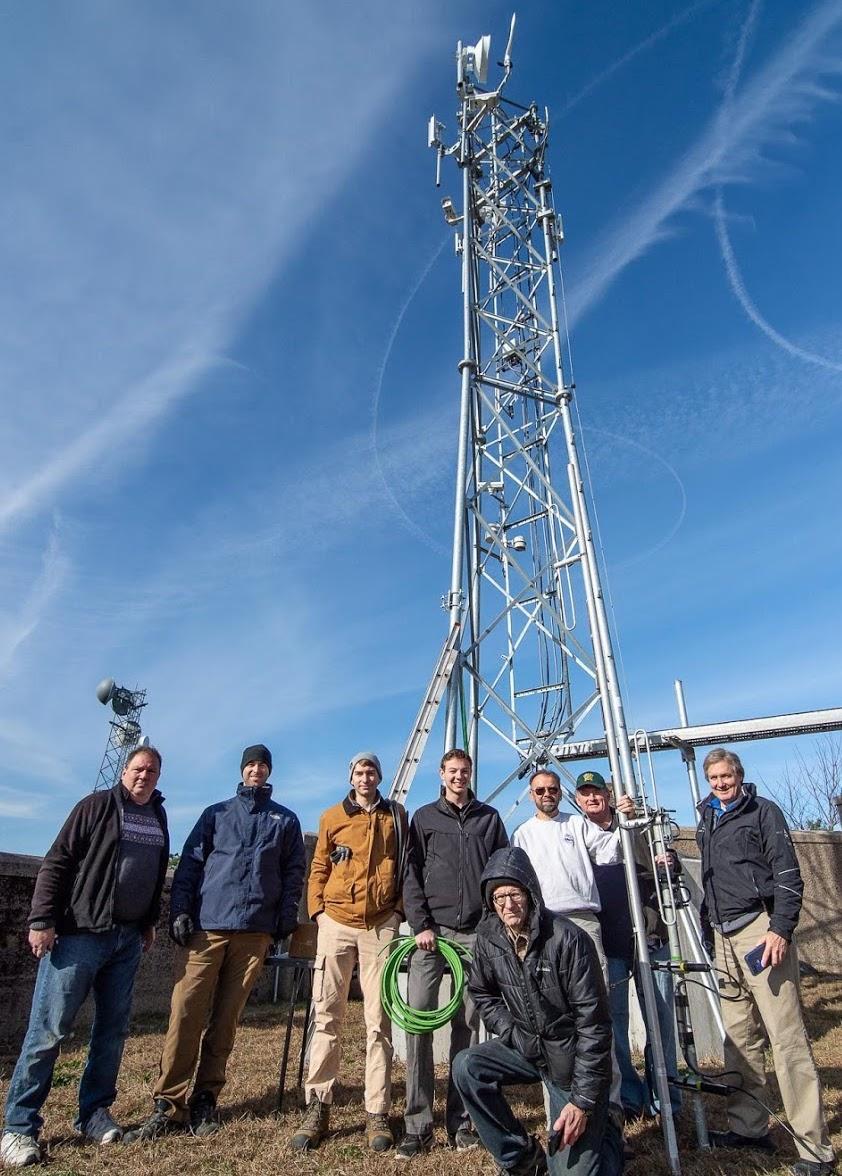
The NESciTech (NEST) collaboration with Blue Hill Meteorological Observatory and Science Center (BHO) is now fully underway. A crew of eight volunteers arrived on November 9, 2019 at Blue Hill to install the antennas and repeaters for the new Blue Hill radio club that the BHO science center is starting with the help of Bob and Rusty at NESciTech.

Thank you Ted for doing much of the tower work, Bob D. for doing most of the repeater configurations and antenna setup, Jeremy for high quality cable connector terminations, and everyone for all your help running coax, hauling equipment, and supporting Blue Hill’s educational mission and STEM collaboration.

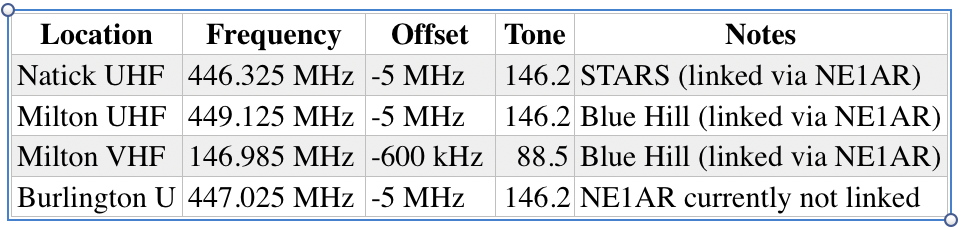
The Blue Hill repeaters will link back to the STARS repeater at NEST in Natick, so talking on one opens all of them. Burlington is by itself for now. Repeaters are open to use by all hams, and shared by Blue Hill Science Center and STARS. Please send any propagation reports to info@NE1AR.org.

Photo, left to right: Bob DeMattia, K1IW; Ted Reimann, W1OG; Jeremy Breef-Pilz, KB1REQ; Alex Dills, KB1SSN; Bruce Pigott, KC1US (kneeling), science center director Don McCasland, Eoghan Bacon, K2VUD; and Bob Phinney, K5TEC. Photographer, not in photo, Rusty Moore, K1FVK.

New England Sci-Tech Technician License Course, December 7-8, 2019

New England Sci Tech logoFor junior high and high school students, homeschool students, and adults interested in wireless communications and electronics, this fast-paced, two-day course will get you ready to take the Amateur Radio Technician license exam.

Topics range from the science of radio electronics to the FCC rules governing the radio spectrum. Some preliminary reading and study is necessary to get the best results from this course. Material will be sent a few days before the course.

The Technician level course runs on Saturday, 9 AM-4 PM and Sunday, 9 AM-1 PM, followed by the FCC Technician exam at 1:00, at New England Sci-Tech, 16 Tech Circle, Natick. [Full description]

New England Sci-Tech General Class Course, Natick, December 14-15, 2019

New England Sci Tech logoFor junior high and high school students, homeschool students, and adults who already have a Technician level license, this fast-paced, two-day course will get you ready to take the GENERAL license exam. Topics range from the science of radio electronics to the FCC rules governing the radio spectrum.  Some preliminary reading and study is necessary to get the best results from this course. Material will be sent approximately a week before the course.

The GENERAL level course runs Saturday, 9 am – 5 pm and Sunday, 9 am to 1 pm, followed by the FCC General exam at noon, at New England Sci-Tech, 16 Tech Circle, Natick.

Included with course fee: printed handouts, lecture study guide, license fee if tested at our location, a guest pass to the NEAR/STARS Radio Room and radio club meetings for 2 months, and free coffee, tea, or hot chocolate during the course. Advance registration and payment required.

For more information and to register, visit <https://www.nescitech.org/product/weekend-general-class/>. For questions, e-mail bobphinney at nescitech.org or call 508-720-4179.

Antenna Raising in Style at New England Sci-Tech Amateur Radio Society

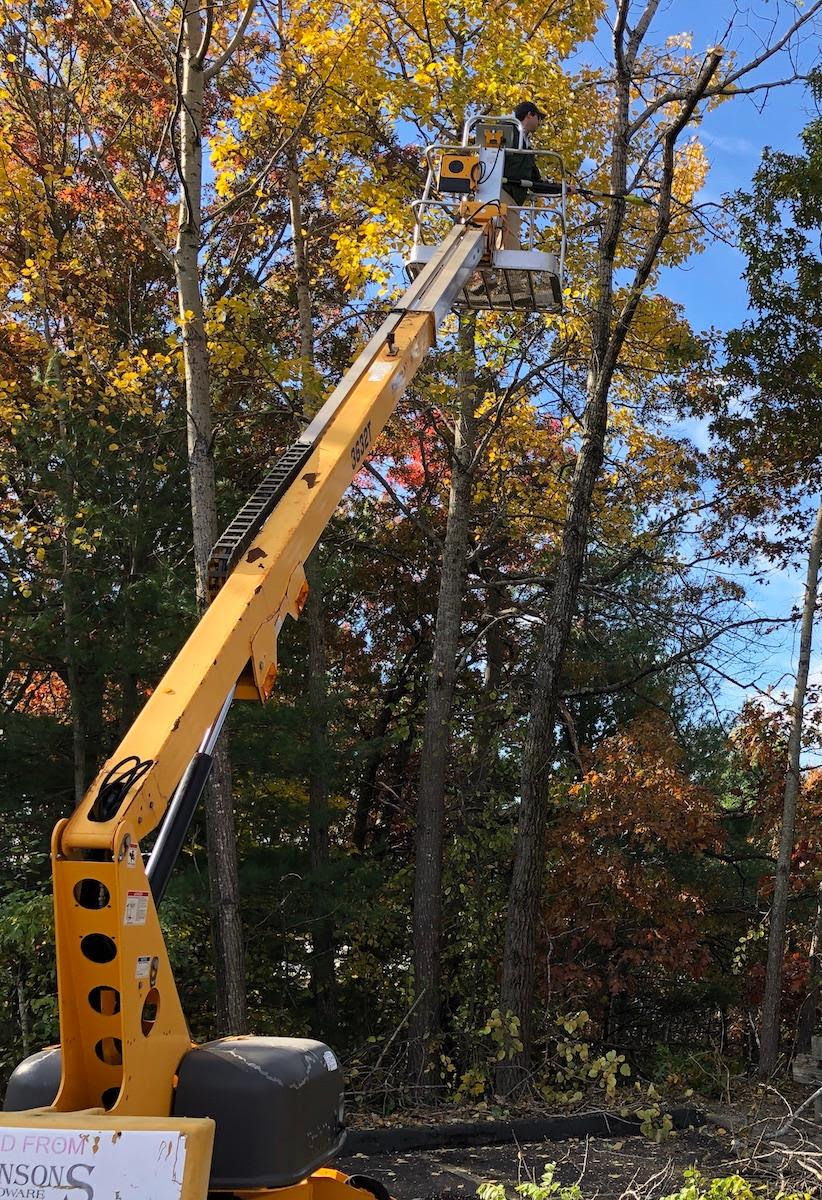
Photo of Ted Reimann, W1OG, in the 2.5 ton bucket lift for tree work to put up the new 80-meter dipole
Ted Reimann, W1OG, in the 2.5 ton bucket lift for tree work to put up the new 80-meter dipole

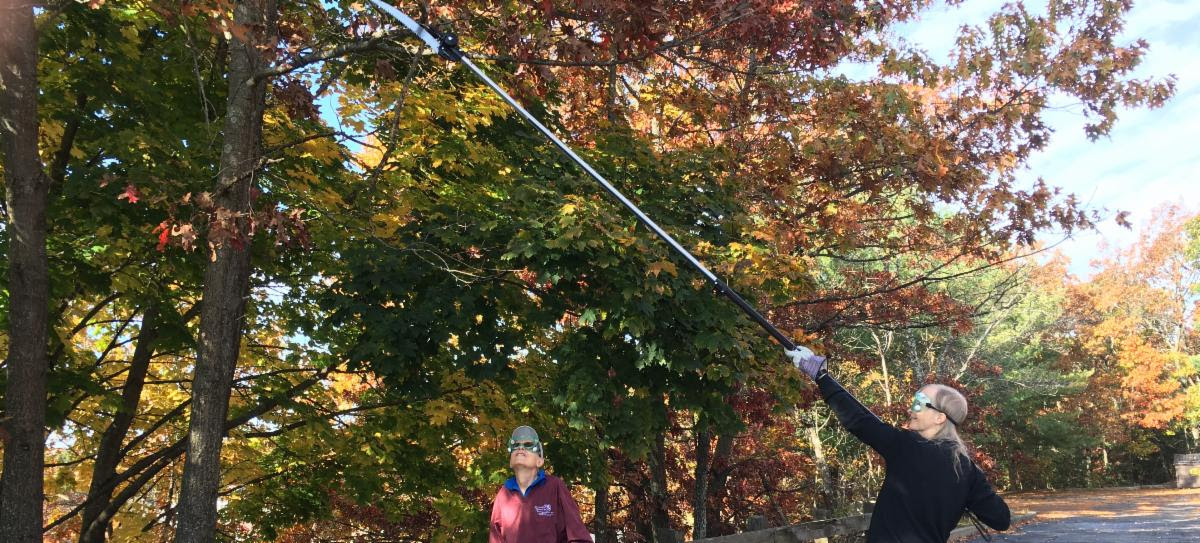
Members of New England Sci-Tech Amateur Radio Society (STARS) held an antenna-raising party to erect an 80-meter antenna on Saturday, October 26, 2019. Members included: Ted, W1OG; Bill, N1WEN; Leandra, AF1R; Alex, KB1SSN; Stu, W1SHS; Barbara, KC1KGS; Dan, W1DAN; Jeremy, KB1REQ; Bob, K5TEC; and Kenneth, KC1AHI.

 
According to Sci-Tech’s Bob Phinney, K5TEC, “A lot of tree limbs had to be cleared to make room for antenna wires. Ted and Alex did most of the work from the bucket lift while the rest of us were ground crew. It was especially helpful to have Bill, Leandra, Alex, and Jeremy helping up to the end, after dark, with the flagpole. And to Alex for bravely running the bucket lift to the top of the flagpole in the dark. “
 
KB1REQ used the antenna to make contacts in the CQ World Wide contest and reports the antenna is working well. 
 
According to Bob, the group still needs help in creating the spring and weight systems at the bottom “to allow for the swaying trees.” Bob also thanked KM1NDY for acquiring the antenna and coax.
Leandra MacLennan, AF1R, with saw while Barbara Irby, KC1KGS spots her, doing tree work to put up the new 80-meter dipole. -W1DAN photo


New England Sci-Tech General Class Course, Natick, November 16-17, 2019

New England Sci Tech logoFor junior high and high school students, homeschool students, and adults who already have a Technician level license, this fast-paced, two-day course will get you ready to take the GENERAL license exam. Topics range from the science of radio electronics to the FCC rules governing the radio spectrum.  Some preliminary reading and study is necessary to get the best results from this course. Material will be sent approximately a week before the course.

The GENERAL level course runs Saturday, 9 am – 5 pm and Sunday, 9 am to 1 pm, followed by the FCC General exam at noon, at New England Sci-Tech, 16 Tech Circle, Natick.

Included with course fee: printed handouts, lecture study guide, license fee if tested at our location, a guest pass to the NEAR/STARS Radio Room and radio club meetings for 2 months, and free coffee, tea, or hot chocolate during the course. Advance registration and payment required.

For more information and to register, visit <https://www.nescitech.org/product/weekend-general-class/>. For questions, e-mail bobphinney at nescitech.org or call 508-720-4179.


Harvard Wireless Club to Participate in the ARRL School Roundup, October 21-25, 2019

Harvard Wireless Club official shieldAllen Liu writes on the Harvard Wireless Club mailing list:

As we mentioned in our previous meeting, we’re going to be participating in the ARRL school club roundup next week. For all you new technicians, you can operate on the global frequencies with one of us General or Extra licensees present, so you can get on the air at our next meeting Tuesday October 22 at 7:30 PM. Contesting is very cool and in this one everyone around the country will want to talk to us as a school club.  We should also have the promised radios ready for you by then.  Let us know if you want to operate at a different time from the 21-25th as well.

New England Sci-Tech Technician License Course, November 2-3, 2019

NE1AR logoFor junior high and high school students, homeschool students, and adults interested in wireless communications and electronics, this fast-paced, two-day course will get you ready to take the Amateur Radio Technician license exam.

Topics range from the science of radio electronics to the FCC rules governing the radio spectrum. Some preliminary reading and study is necessary to get the best results from this course. Material will be sent a few days before the course.

The Technician level course runs on Saturday, 9 AM-4 PM and Sunday, 9 AM-1 PM, followed by the FCC Technician exam at 1:00, at New England Sci-Tech, 16 Tech Circle, Natick. [Full description]

Several Eastern MA Stations QRV for JOTA, October 18-20, 2019

Several Eastern MA individuals/groups have registered to operate in the Jamboree On The Air (JOTA) festivities October 18-20, 2019:

Mark Hofstra, KA1YQC, will conduct operations on behalf of the Mayflower Scout Council from Franklin for the full weekend.

The Spirit of Adventure Council will be represented using Ryan Bardsley’s call sign, KC1EIL, from Manchester-by-the-Sea from October 18-20.

Don Burke, KB1LXH, will activate KC1TAC on behalf of the Narragansett Council from Camp Norse in Kingston on Saturday, October 19, only.

We wish the best of luck to these groups (and others who might not have registered)!

Northeastern Wireless Club to Participate in ARRL School Roundup, October 21-25, 2019


“The Northeastern University Wireless Club will be participating in the ARRL School Club Roundup next week. Come by the club space anytime next week to see us make contacts with other amateur radio school organizations around the world! Even if you don’t have a license, you can still participate under the supervision of one of our licensed members.” -via NEU mailing list

Northeastern University Wireless Club Fall 2019 Electronics Projects

The Northeastern University Wireless Club has announced a number of exciting projects for Fall 2019. If you want to join any of the projects below, contact their lead on Slack, and find their meeting times on the Google calendar.

Airlights+
First Meeting Tuesday 4pm
Contact: Jack Leightcap
Airights+ is working to improve the LED controller in the Wireless Club space. This team will have a good mix of software and hardware, with a lot of python programming as well as board design.

LED Flag
First Meeting Thursday 6pm
Contact: James Packard
The LED Flag is a device Wireless Club currently uses to advertise at club fairs and similar events. This team is looking to improve the device by overhauling the software, redesigning the user interface, and enabling the device to be battery-powered. This group is looking for hardware and software support!  Support is available from the club if someone wants to learn about this but doesn’t feel confident to do it alone.

RFID
First Meeting Thursday 6pm
Contact: Thomas Kaunzinger
RFID is working on a device for Wireless Club that will allow for rapid attendance for club events using a Husky Card and RFID reader. Their goal is to create a device which allows for Husky Cards to be read, and the software to interface with and log this data. There will be board design, firmware design, and software design (probably including databases) for this project.

Crude Camera Sensor
First Meeting Tuesday 6pm
Contact: Henry Mayne
This group is looking to create a rudimentary camera sensor using photodiodes or a similar device. This project is still in the early stages of development with idea generation, so if you are interested bring your ideas! There will be significant hardware development and design required, as well as firmware/software to read the output from the sensor built.

New England Sci-Tech General Class Course, Natick, October 19-20, 2019

New England Sci Tech logoFor junior high and high school students, homeschool students, and adults who already have a Technician level license, this fast-paced, two-day course will get you ready to take the GENERAL license exam. Topics range from the science of radio electronics to the FCC rules governing the radio spectrum.  Some preliminary reading and study is necessary to get the best results from this course. Material will be sent approximately a week before the course.

The GENERAL level course runs Saturday, 9 am – 5 pm and Sunday, 9 am to 1 pm, followed by the FCC General exam at noon, at New England Sci-Tech, 16 Tech Circle, Natick.

Included with course fee: printed handouts, lecture study guide, license fee if tested at our location, a guest pass to the NEAR/STARS Radio Room and radio club meetings for 2 months, and free coffee, tea, or hot chocolate during the course. Advance registration and payment required.

For more information and to register, visit <https://www.nescitech.org/product/weekend-general-class/>. For questions, e-mail bobphinney at nescitech.org or call 508-720-4179.