New England Sci-Tech General Course, Natick, July 25-26, 2020

New England Sci Tech logoFor junior high and high school students, homeschool students, and adults who already have a Technician level license, this fast-paced, two-day course will get you ready to take the GENERAL license exam. Topics range from the science of radio electronics to the FCC rules governing the radio spectrum.  Some preliminary reading may be helpful to get the best results from this course. Material will be sent approximately a week before the course.

The GENERAL level course runs Saturday, 8:30 am to 5 pm and Sunday, 8:30 am to noon, followed by the FCC General exam at noon, at New England Sci-Tech, 16 Tech Circle, Natick.

Included with course fee: printed handouts, lecture study guide, license fee if tested at our location, a guest pass to the NEAR/STARS Radio Room and radio club meetings for 2 months, and free coffee, tea, or hot chocolate during the course. Up to two members of the same family may take this course for the price of one. Please let me know if there will be two of you attending.

For questions, e-mail bobphinney at nescitech.org or call 508-720-4179.
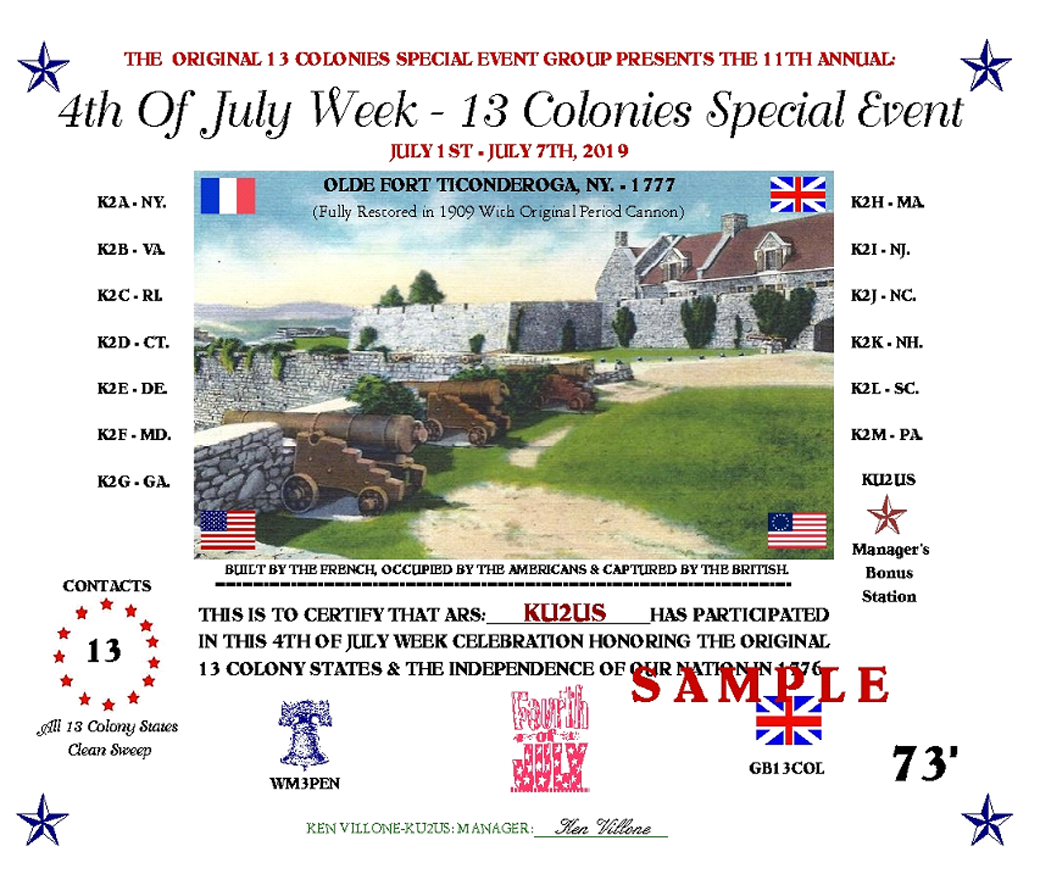
13 Colonies Event Week, July 1-7, 2020

13 Colonies sample certificateBob Kelley, K1KVV, writes on the Southeastern MA ARA web site:

13 Colonies Event Week

July 1, 9AM to July 7, Midnight, EDT
(1300Z 1 July 2020 to 0400Z 8 July 2020)

Certificate: Only one 13 Colonies QSO gets you a certificate.

For a CLEAN SWEEP, you don’t need to work the Bonus Stations, WM3PEN & GB13COL.
[D-STAR is OK for Bonus Stations]

Working a Colony Station: use DX Summit www.DXSummit.fi to find 13 Colonies S/E station.

Spotting: after working a colony station, you are encouraged to spot it on DX Summit: i.e., “K2H 13 Col MA.”
Questions? See KU2US www.13colonies.us.

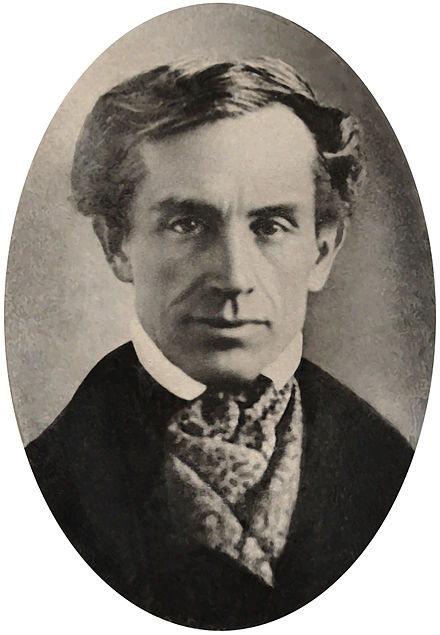
On This Date in 1840: Samuel Morse Receives Patent for “Morse code” System

Samuel MorseOn this date in 1840, Samuel Morse received a patent for his “Morse code” system. Morse was a painter, originally. He also studied photography with Louis Daguerre in France, and brought the new technology to America, where he opened a photographic studio in New York City. He became interested in telegraphy after he failed in his bid to become the mayor of New York. During a demonstration of one of his early telegraph machines, he met Alfred Vail, a young mechanical engineer. Vail was fascinated by the telegraph, and he convinced Morse to bring him aboard as an assistant. Vail helped Morse work out some problems with Morse’s original system, and it didn’t hurt that Vail’s father was a wealthy industrialist. Vail put up the money to pay the patent application fees in exchange for a share in whatever resulted.

The telegraph works by sending an electromagnetic signal over a wire. Morse had an idea that the current could be used to move a pencil along a moving strip of paper, but Vail simplified it by suggesting a cheaper and more practical alternative: an arm that would bounce up and down. The pair then had to devise a way to convert a tapping arm into a system of language. It was actually Vail, not Morse, who came up with the first dot-and-dash system, with each letter and number being made up of a different combination of long and short sounds or flashes. Vail’s first message using his code was, “A patient waiter is no loser.” But Morse was the better known of the two inventors, and it was his name on the patents, and that’s why we call it “Morse Code” and not “Vail Code.” -From Garrison Keillor’s The Writer’s Almanac, June 20, 2020.

Web Site Changes

Eastern MA ARRL logoSome minor structural changes were made this weekend to the ema.arrl.org web site.

The “Government” menu and category have been renamed to “Regulation & Advocacy” duplicating the ARRL Hq. web site references. Also, the “Field Day” menu item is now in alphabetical order. (It used to be last on the menu because it was the newest created item.)

Your webmaster has added a “font size” widget (three capital “A” letters of increasing font size) in the upper right corner.  (I like the flexibility of changing font size via the plug-in instead of messing with my computer settings.)

Finally, the “share to social media” plug-in was replaced with a better version.  The icons appear at the bottom of each story. It’s now easier than ever to share an story to Facebook, Twitter, e-mail, LinkedIn, etc.

K1USN Radio Club On-line Meeting, June 23, 2020

“Pi” Pugh, K1RV, writes on the K1USN RC mailing list:
 
Our discussion topic on Tuesday, June 23rd @ 7:30 PM will be 2020 ARRL Field Day plans.
 
We want to hear from you to learn what you expect to do for the 2020 ARRL Field Day. Obviously there are extenuating circumstances this year due to the Covid-19 Pandemic.
 
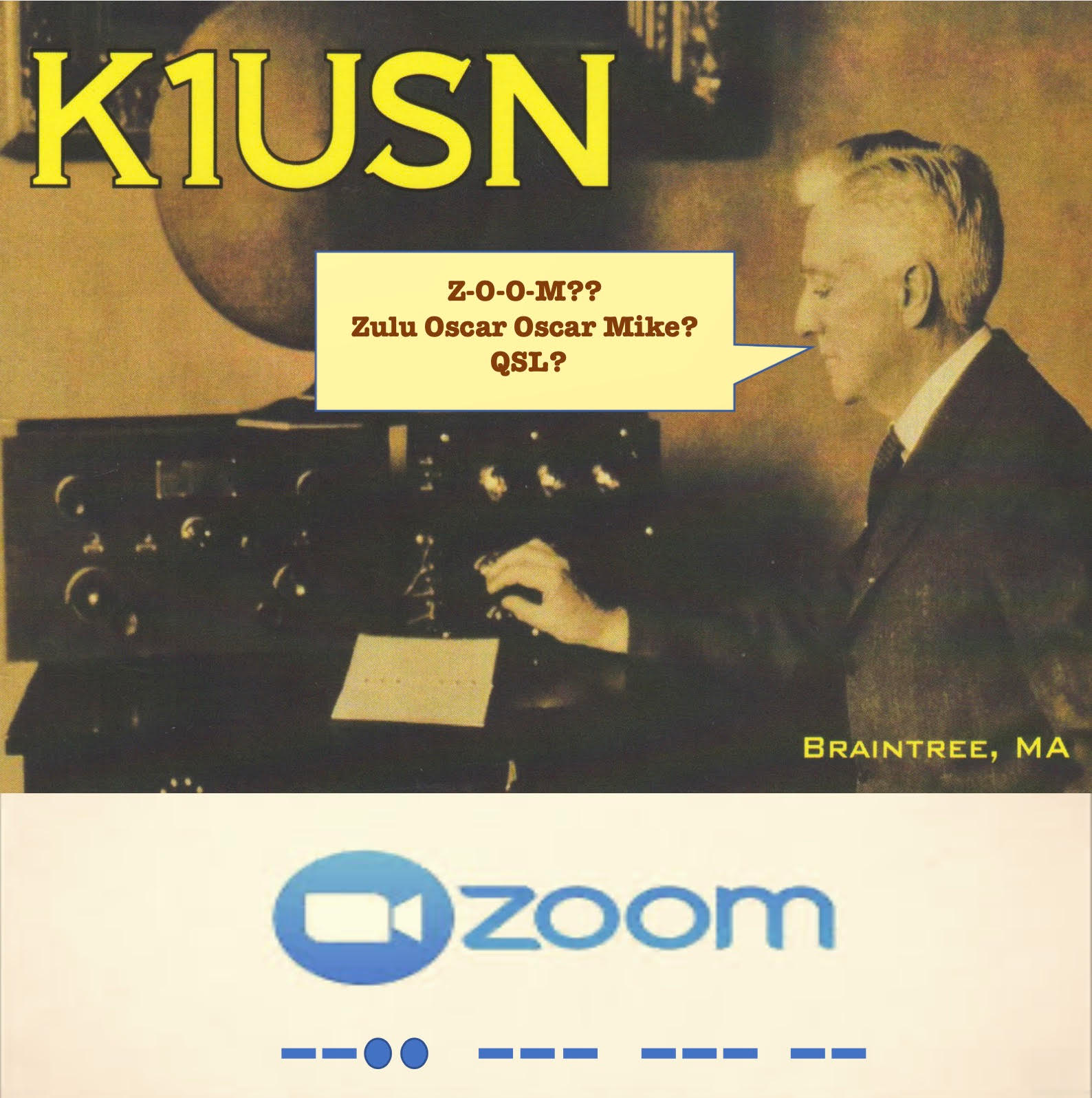
The recent K1USN Zoom session presentation by Bruce – K1BG about his past one person Field Day operation may have given you some ideas on how you might operate.
 
Do you plan to get on the air during the weekend of June 27 – 28 for Field Day 2020? If so, what class to you intend to operate? What modes will you operate? Will you use computer logging/ If so, which software?
 
Let’s have a lively discussion so that perhaps you might give others some ideas about what direction to choose. I suspect that I may choose to operate 1D class from my home station using N1MM+ logging software using K1RV.
 
I am also considering the possibility of using my KX3 on battery power into a Buddipole Vertical using N1MM+ logging software from my back patio for a few hours during the day as K1USN.
 
Here is the ARRL Field Day rules page – http://www.arrl.org/field-day.

Zola Center ARC On-line Meeting-Presentations, June 20, 2020

The next meeting of the Zola amateur radio group will be held on Saturday, June 20, 2020 beginning at 11AM EDT. The meeting will be held entirely on a Zoom tele-conference. There will be no in-person component. Please see the call in/sign in information below my signature. This month’s agenda:

11 AM – Come to order and introductions

11:05 AM – Announcements and questions

11:15 AM –

Ms. Donna Suskawicz is a founding member of the Zola Amateur Radio Group. Without her vision, dedication, and generosity there would not be such an organization. She will give us a presentation about the history and mission of our organization. Donna is a real inspiration for us, and we look forward to a very informative presentation.

12 Noon –

Mr. Rob Santello is an inventor and engineer. He designs and produces a product known as a Ham Pod. The Ham Pod device communicates through serial protocols to a variety of amateur radio rigs, rotor controllers, and meters. It features an interactive keypad and voice output. Rob will tell us about the history of his invention and the myriad of uses it has.

12:45 PM – New business and topics for the good of our community.

1:30 PM – Adjourn


Sincerely,

Frank Ventura, N1FMV

frank@littlebreezes.com

[Ed: Contact N1FMV for Zoom conference meeting details]

Non-ham Signals on 160 Meters

Art Bernstein, N2KA, writes on the Yankee Clipper Contest Club mailing list:

Some time ago I posted a bit concerning whether or not anyone was hearing a signal on 160 meters, just at and above the FT8 frequency of 1840 kHz. I received some suggestions and also that no one else was hearing it.

After doing a lot of eliminating around the shack and determining it was coming from the outside, I did some research to find out who transmits on 160 meters in addition to Radio Amateurs.

What I found was interesting and brought back some memories from years ago I had never experienced.

Fishnet Buoy Beacons. For those not knowing what they are, they are buoys that help fishermen locate their nets that have been left to catch fish. I would have thought GPS would be used these days. These beacons typically have a range of 10-15 miles over salt water and I probably live around 10 miles or less from the salt water. Normally it wouldn’t be a problem when using narrower bandwidths on CW or SSB, but on FT-8 bandwidths are typically 3-5 kHz wide. At night the zero beat frequency is about 1841.35, during the day I just checked it to be a couple hundred Hz higher (drift due to heating?)

Anyone have any ideas regarding procedures to follow here? It is likely an unlicensed radiator interfering with a licensed service. It has no identifier. Already sent message to ARRL Regulatory desk and to Division Leader.

Thanks.

73,

Art., N2KA


Whitman ARC to Begin Remote Training over Zoom

Whitman ARC logoFrom the Whitman ARC June 2020 newsletter:

“[Ross Hochstrasser, W1EKG] reported that we will now be able to do remote classes using ZOOM. The first item on the list is to help the folks in the Extra class via Zoom session with additional training and review to allow them to take the Amateur Extra exam before the new question pool takes effect July 1, 2020.

“There is a new training email address that was set up by Randy, KC1EFF. This will be used just for training inquiries and other info. The new email address is Warc.Training@gmail.com.”

PART of Westford Meeting Online, June 16, 2020

PART of Westford logoGeorge Allison, K1IG, writes on the PART of Westford mailing list:

Our next club meeting will be conducted via Webex video conference starting at 7:30 PM on Tuesday, June 16.  As usual, you can check in after 7:00 PM to test your equipment. See below for the login information.

The topic of this meeting is Field Day. I hope you’re all planning on making at least a few contacts from your home station or a portable setup and adding to the PART score. This year’s Field Day could have more stations on the air than ever before, so it’s your opportunity to make a LOT of contacts!

At this meeting we’ll go over:

  • How you can participate from home
  • Types of stations you can set up and the Field Day exchange for each
  • How to make contacts and log them. Technicians are part of this event too; we’ll set up special times for Techs (and others) to make contacts on VHF/UHF
  • How to get bonus points
  • How to submit an entry — we’ll walk you through the entry form and show you how to properly enter data to give yourself and the club the most points.

You can get a head start by reading the Field Day rules here.  If you have questions, you can ask them at the meeting.  After the meeting I’ll send out a summary of important information.

At the end of my presentation, I’ll invite you to tell the club what you plan to do for Field Day.

[Contact George Allison, K1IG, for Webex conference meeting information at k1ig -at- arrl -dot- net]

New England Sci-Tech Technician Course Online, June 16-19, 2020

New England Sci Tech logoFour day course: Tu-W-Th-Fri June 16-19, 3-6 pm each day Eastern Time

For anyone interested in wireless communications and electronics, this ON-LINE course will get you ready to take the Amateur Radio TECHNICIAN license exam, the FIRST of three certification levels. Geared toward adults, as well as junior high, high school, and homeschool students.

Topics range from the science of radio electronics to the FCC rules governing the radio spectrum. Some pre-test practice is necessary to get the best results from this course.

This is a FULL course taught by a 40-yr veteran teacher, not a discussion group or video service. You will learn so much more than just watching a video or buying a book.

The FCC Technician test will be scheduled for an upcoming weekday evening or weekend, as an online test, run by our VE team which has authorization to run online tests.

System Requirements: Computer or Chromebook capable of running ZOOM Meeting, either by Zoom app or through a browser, a built-in camera/mic, and a color printer.

Included with course fee: downloadable lecture study guide and charts, free access to our weekly Online Radio Shop Talk sessions, and a guest pass to the NEAR/STARS Radio Rooms and radio club meetings for 3 months once the facility reopens.

Note that the standard $15 license test fee is NOT included and must be registered separately; our VE team is authorized to give ONLINE exams, so you can schedule an exam within a week of the course. (Price is $15 across the country.)

An additional member of the same family may join this course at no extra charge, if sharing one computer and zoom screen.

A few hours before the session you will receive an email with a Zoom link and ID. If you don’t see the email, check your spam filter. If you still don’t see it, call 508-720-4179 for help.

For questions, e-mail bobphinney at nescitech.org or call 508-720-4179.
New England Sci-Tech General Course Online, June 20-21, 2020

New England Sci Tech logoTwo day course: SAT-SUN June 20-21, 12:00-6:00 pm Eastern Time each day

For anyone interested in wireless communications and electronics, this ON-LINE course will get you ready to take the Amateur Radio GENERAL license exam. Geared toward adults, as well as junior high, high school, and homeschool students.

Topics range from the science of radio electronics to the FCC rules governing the radio spectrum. Some preliminary preparation is necessary to get the best results from this course.

This is a FULL course taught by a 40-yr veteran teacher, not a discussion group or video service. You will learn so much more than just watching a video.

The FCC General test will be scheduled for an upcoming weekday evening or weekend, as an online test, run by our VE team which has authorization to run online tests.

System Requirements: Computer or Chromebook capable of running ZOOM Meeting, either by Zoom app or through a browser, a built-in camera/mic, and a color printer.

Included with course fee: downloadable lecture study guide and charts, free access to our weekly Online Radio Shop Talk sessions, and a guest pass to the NEAR/STARS Radio Rooms and radio club meetings for 3 months once the facility reopens.

Note that the standard $15 license exam fee is NOT included and must be registered separately; our VE team is authorized to give ONLINE exams, so you can schedule an exam within a week of the course. (Price is $15 across the country.)

One additional member of the same family may take this course for the price of one, if sharing one computer, video screen, and materials.

A few hours before the session you will receive an email with a Zoom link and ID. If you don’t see the email, check your spam filter. If you still don’t see it, call 508-720-4179 for help.

For questions, e-mail bobphinney at nescitech.org or call 508-720-4179.
Volunteer Monitor Program Recognizes Good Operators

FCC sealFrom ARRL Web:

06/11/2020 – Volunteer Monitor Program Coordinator Riley Hollingsworth, K4ZDH, said the program has recognized numerous radio amateurs with Good Operator Notices.

“One facet of the ARRL and FCC agreement that set up the Volunteer Monitor Program calls for ARRL to recognize especially good amateur radio behavior, in order to encourage compliance with FCC rules and further the efficiency of the Amateur Radio Service,” Hollingsworth said. “Seventeen operators in 15 states received Good Operator Notices in the first quarter of 2020. The Good Operator Notices went to veteran operators as well as newcomers, including a 13-year-old in North Carolina for CW operation during the Youth on the Air Special Event, and a 14-year-old in Wyoming for SSB operation.” [Full story]

KD1D Fox is “On the Loose” in Westford, June 12, 2020

Alan Hicks, KD1D, writes on the writes on the NE Mass Foxhunters  list at 5:16 PM on June 12, 2020:

I found a nice den for the fox in Westford.  It has a new case and a bigger battery (which I expect to last well into next week).
 the KD1D Fox transmits about 30 seconds on and 30 seconds off and can be heard telling an old tale. It is transmitting on 146.565 MHz and is in a location that won’t interfere with Barry’s Littleton fox,

If you need some help, just ask and I will provide clues, such as:

“It’s not far off the beaten path.”  and
“Warmly greet the chef.”

There is a logbook next to the transmitter, but you can also just confirm where and when you found it by:

Email: kd1d@arrl.net
Voicemail or text: 978-376-2267

Happy hunting and stay safe!

73,
Alan KD1D

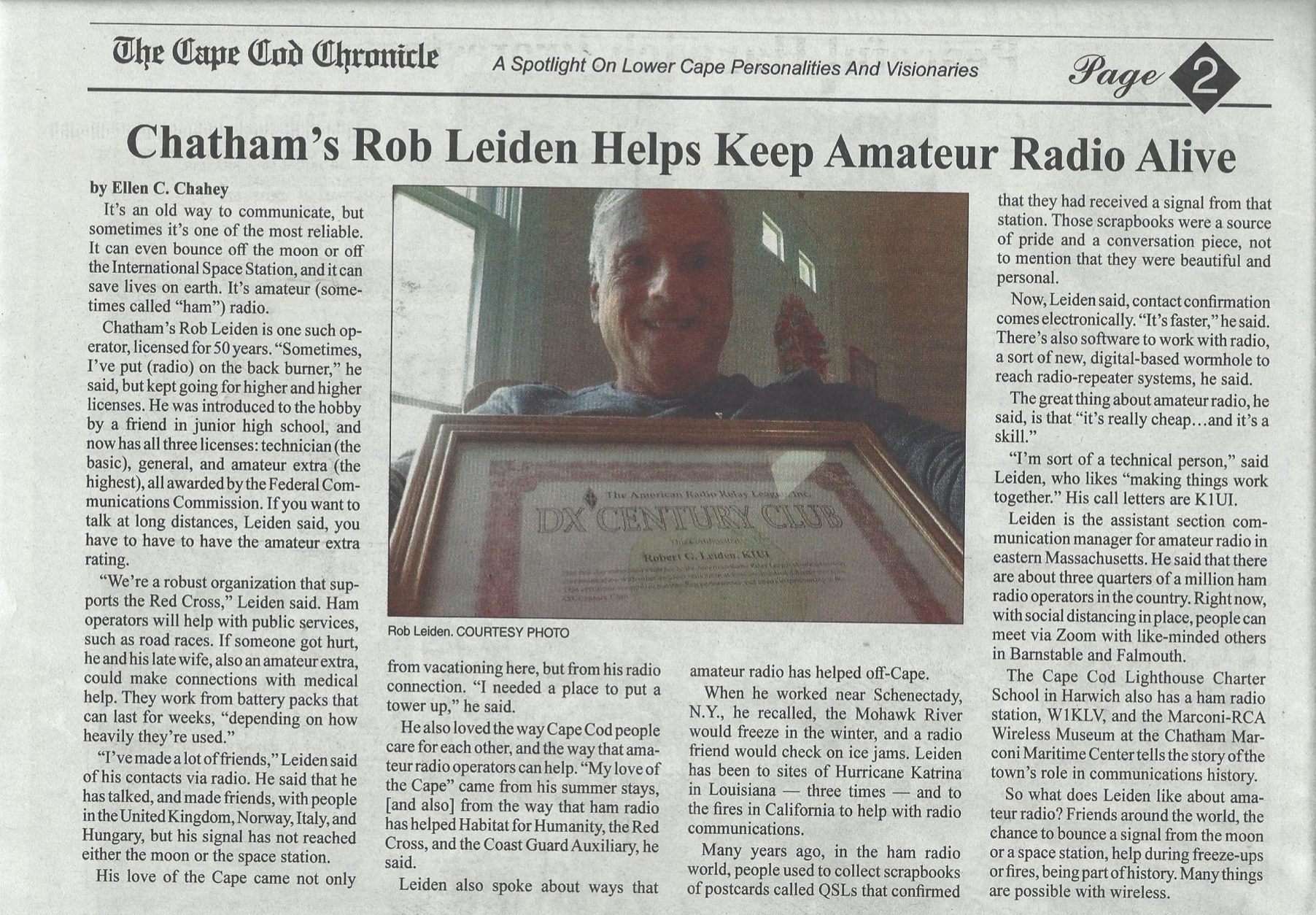
“Chatham’s Rob Leiden Helps Keep Amateur Radio Alive”

Eastern MA Assistant Section Manager Rob Leiden, K1UI, is featured in, “A Spotlight on Lower Cape Personalities and Visionaries” in the June 11, 2020 issue of the Cape Cod Chronicle. The article entitled, “Chatham’s Rob Leiden Helps Keep Amateur Radio Alive” describes Rob’s entry into the hobby in junior high school, his DXing activities, and work with the American Red Cross. The article also mentions the Cape Cod Lighthouse Charter School club station in Harwich and the Marconi-RCA Wireless Museum at the Chatham Marconi Maritime Center

Waltham ARA Field Day Training Sessions, June 17 & 24, 2020

Eliot Mayer, W1MJ, writes on the Waltham ARA mailing list:
In preparation for “[Waltham Amateur Radio Association] Field Day 2020 – Alone Together”, the club will hold two online training sessions.

Wednesday, June 17, 2020, 7:30 – 830 PM: N1MM Logger
Wednesday, June 24, 2020, 7:30 – 8:30 PM: FD 2020 Q&A

It would be helpful if you install the latest version of N1MM Logger Plus from https://n1mmwp.hamdocs.com/ before the June 17 session, or at least try, so that you will know what you don’t know. If you are new to N1MM, be sure do the “Full Install” and then the “Latest Update”.

Prior to the June 24 meeting, check out official FD site http://www.arrl.org/field-day and K8GT’s excellent presentation about FD 2020: http://tiny.cc/fdsd

The links to these online sessions will be provided by Ron, KG1T, on this Yahoo Group.

Algonquin ARC QRV for Field Day 2020 from Crow Island

The Algonquin Amateur Radio Club will operate Field Day from Crow Island in Stow on June 27 or the evening of June 26. 

“Please email the activities chair for more information,” writes Joe Reynolds, KA1GDQ.  (ka1gdq -at- arrl -dot- net.) “We will have to social distance and can’t have any more than ten people at a time at the location.”

Joe requests those wishing to help out with set up/break down or operating to provide him with the following information:

  • Name:
  • Call:
  • Position:   Operate  / Setup  / Breakdown
  • Days and times  you would like to be there
  • Friday night setup
  • Saturday 
  • Sunday  (end operating no later than 2 PM, out by 3-3:30 PM)

Boston ARC Meets Online, June 18, 2020

Boston ARC logoJoe Chapman, NV1W, writes in The SPARC, June 2020:

The June General Meeting [of the Boston Amateur Radio Club] will be held at the usual date and time, Thursday, June 18, at 7:30 p.m., but on the Zoom teleconferencing platform instead of in person in Brookline Village. Zoom clients are available for many platforms at https://zoom.us. We are grateful to Phil Temples, K9HI, for assisting with setting things up.

June is the Elections meeting, and if you are interested in running for a club office, please contact either Vice President Mark Duff, KB1EKN, or myself. Nominations will of course be open until the election itself, so contacting either one of us is optional.

We will also be discussing individual plans for Field Day.

Here is the drill: I will send out a link for the meeting to the SPARC email distribution list on the afternoon of the 18th . It should have everything you need to join the meeting. Talk-around will be on the 145.230 Boston repeater, and I will be listening in case anyone runs into any issues.