Field Day: “A Difference Experience in the COVID-19 Environment”
 Rick Palm, K1CE, writes in the ARRL ARES Letter, May 20, 2020:
ARRL Field Day is my favorite operating event of the year. For most radio clubs and large groups, it’s going to be a different experience this year in light of the COVID-19 environment. With CDC protocols in place, many will not gather in their usual Field Day locations. ARRL offered some tips and suggestions to help you plan this year’s operation — ARRL Suggests Taking a Creative Approach to Field Day 2020. A few of them applied to my own recent operating experiences and thought I would share as possible inspiration.
My personal, longtime Field Day experience revolves around my recurrent entry class: 1E – home station on emergency power, yes, the “couch potato” class. It’s easy to look down on us E class operators but every year I learn something new about my station and operation, usually dealing with 12V power management and solar panel efficiency, etc. “Remember, Field Day is a non-adjudicated operating event and not a ‘full speed ahead’ contest,” says ARRL.
The League also suggests not forgetting about 6 meters: FD is not an HF-only event. Summer propagation on the “Magic Band” can be interesting and sometimes thrilling. This past year, I have used my 40-meter dipole to work local stations on 6 meters. I just ordered a three element 6 meter Yagi. I’m looking forward to trying it for FD (and the preceding June VHF Contest) for openings.
Recently I have had a blast discovering FT8 and the underworld (under the noise-level world, that is) of weak signal work. A suggestion from colleague Mike Corey, KI1U, and the WSJT suite of weak signal software opened this door to excitement for me. I’m not sure how to configure it for Field Day yet, but that will give me something fun to learn and apply before next month’s event. The software reportedly does support the ARRL Field Day exchange.
It strikes me that derivatives of FT8 will render high value modes for emergency/disaster response communications when conditions are less than optimal, its essence. See, for example, JS8Call. JS8Call is a digital mode built on the popular FT8 protocol; however, it instead offers real-time keyboard-to-keyboard messaging as well as store-and-forward capabilities and other similar features.
Remember: In Field Day, “a premium is placed on developing skills to meet the challenges of emergency preparedness as well as to acquaint the general public with the capabilities of Amateur Radio.” – ARRL Field Day Rules
“We don’t rise to the level of our expectations. We fall to the level of our training.” – Archilochus
 Rick Savage, KB1LYJ, writes on the North Shore RA mailing list:
 For anyone interested in wireless communications and electronics, this ON-LINE course will get you ready to take the Amateur Radio GENERAL license exam. Geared toward adults, as well as junior high, high school, and homeschool students.
 For anyone interested in wireless communications and electronics, this ON-LINE course will get you ready to take the AMATEUR EXTRA Radio license exam. Geared toward adults, as well as high school and homeschool students.
 Dan Brown, W1DAN, writes on the Wellesley ARS mailing list:
 The ARRL Board of Directors recently voted to create a special Life Membership opportunity for individuals who are at least 70 years old. Starting on June 1, the Life 70+ Membership will be available to individuals who have turned 70 and have a combined 25 years of paid annual ARRL membership.
 “Pi” Pugh, K1RV, writes on the K1USN mailing list: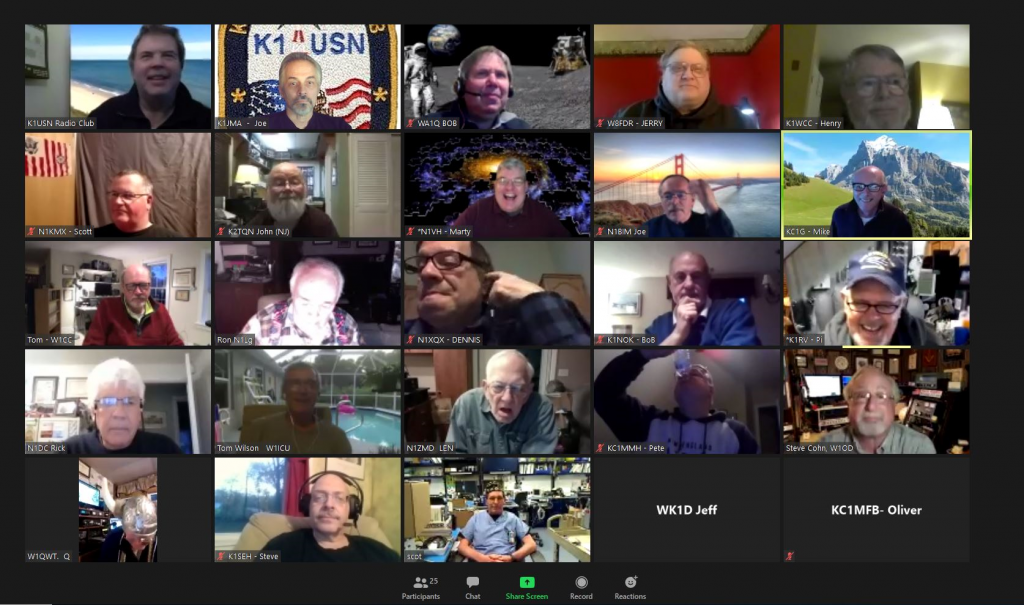
 Ray Cord, K2TGX, writes on the Sturdy Memorial Hospital ARC mailing list:
 John Dorr, K1AR, writes on the Yankee Clipper Contest Club mailing list:
 “The May 19
  The
The  “Pi” Pugh, K1RV, writes:
 The following correspondence was posted on the ARRL-Awards mailing list on May 8, 2020 in response to a query about a pending award:
 Sumner Weisman, W1VIV, writes on the Framingham ARA mailing list:
 Hi everyone,
 From ARRL Web:
 Dave Sumner, K1ZZ, writes on the ARRL-IARU list: