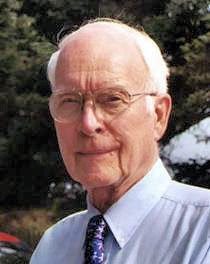
Researcher and Past Arecibo Observatory Director Gordon Pettengill, W1OUN, SK
 From the ARRL Letter, May 27, 2021:
Renowned physicist, astronomer, and past Arecibo Observatory Director Gordon Pettengill, W1OUN, of Concord, Massachusetts, died on May 8. An ARRL member, he was 95.
“He was instrumental [as Arecibo Observatory Director] in getting some ‘telescope time’ at that facility for hams to do EME (moonbounce) on 432 MHz, giving a lot of hams with modest stations a shot at making a QSO via moon reflection,” said Chip Taylor, W1AIM. “He was the first person to use that big dish to do radar mapping of the surface of Venus, Mercury, Mars, and various asteroids and comets. And he was a mentor to many of us interested in microwave communication.”
A World War II combat veteran, Pettengill completed his bachelor’s degree at MIT after the war, then received a doctorate in high-energy physics at the University of California-Berkeley. His career in radio astronomy took off when he joined MIT Lincoln Laboratory, using the Millstone Radar in Westford, Massachusetts, for astronomical observations.
In 1963, he moved to the newly opened Arecibo Observatory. He was named its director in 1968. In 1977, he was Principal Investigator of the radar aboard the Pioneer Venus Orbiter that created the first near-global topographic map of any planet, and in the 1990s he was the Principal Investigator of the Magellan mission to Venus.
Pettengill was elected to the National Academy of Sciences in 1979, and served as Director of MIT’s Center for Space Research from 1984 until 1989. He received a Guggenheim Fellowship in 1980 and spent his sabbatical at the University of Sydney, Australia. He retired in 1995. He was active on the air until recently.

 Marcia Forde, KW1U’s PowerPoint slides from her May 20, 2021 ARES Workshop presentation on the “National Traffic System” are now
  Boston Globe reporter Gabriella Gage writes this nice human interest story in the May 22, 2012 issue of The Boston Globe:
 George Allison, K1IG, writes on the PART of Westford mailing list:
 From
From 
 The
The  Gordon West, WB6NOA, will will be the guest speaker at the May 13, 2021 Algonquin Amateur Radio Club meeting at 7:30 PM online via Zoom. Other club business topics include election results, updates on May’s Hazmat Day and 2021 school watch, and discussion of hardware upgrades on the club K3.
 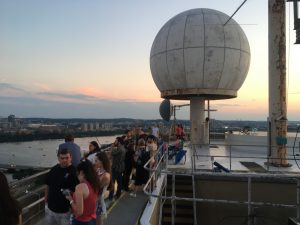 Perched atop the MIT Cecil and Ida Green Building (Building 54), MIT’s tallest academic building, a large, golf ball-like structure protrudes from the roof, holding its own in the iconic MIT campus skyline. This radar dome — or “radome” for short — is a fiberglass shell that encases a large parabolic dish, shielding it from the elements while allowing radio waves to penetrate. First installed in 1966, it was used initially to pioneer weather radar research. As the years passed and technology evolved, the radome eventually fell out of use for this purpose and was subsequently slated for removal as MIT began a major renovation and capital improvement project for the building. That’s when the student-led MIT Radio Society, who had found creative new uses for the radome, sprang into action to save it — and succeeded. [
 Ham Radio and Software Defined Radio – An Overview, Some History, and a Demonstration
 Phil Erickson, W1PJE, writes on the NVARC mailing list:
 Henry Brown, K1WCC, writes on the Falmouth ARA Facebook page: