Cape Cod & Islands ARES Operation “Ice Show” Winter Exercise, January 25, 2020

Cape Cod ARES logoFrank O’Laughlin, WQ1O, writes:

The Cape Cod and Islands District Amateur Radio Emergency Service will conduct a winter operations exercise on Saturday, January 25, 2020, to test its capability in establishing communications with stations within its district and outside it under emergency conditions.

The operational exercise, dubbed “Ice Show” will test the ability of several field stations to communicate. This will also be a drill to test some of our hospital stations, primary stations, EOCs, shelters and other ARES member home stations.

Version 1.2 of the exercise scenario and guidelines are available online. 

Setup will begin at 8:30 AM, with a start time of 10:00 AM lasting until 12 Noon.

Nashoba Valley Amateur Radio Club Assists in Post-earthquake Support for Arecibo Telescope in Puerto Rico

Phil Erickson, W1PJE, writes:

In January of this year, Puerto Rico was struck by another natural disaster in the form of frequent significant earthquakes and aftershocks.  Although quake epicenters were in the southwest island corner, tremors were felt all across the island in what has been described as a 100 year class series of events.  Earthquake impacted areas included the landmark Arecibo radio telescope and ionospheric radar facility, previously a victim of the August 2017 devastation wrought by Hurricane Maria.

In response to the situation, members of the Nashoba Valley Amateur Radio Club rapidly stepped up to assist in support and recovery efforts for the world’s largest radio and radar facility.  In particular, NVARC members Phil Erickson, W1PJE; Rod Hersh; WA1TAC; and Jim Wilber, AB1WQ, participated in daily scheduled QSOs with Angel Vazquez, WP3R, the lead Arecibo telescope operator and spectrum manager.  WP3R’s longtime ham radio credentials include the 2019 Yasme Foundation award for his work in disaster relief on the island during Hurricane Maria.  NVARC members Bill Blackwell, AB1XB, and Les Peters, N1SV, also quickly volunteered time on their home stations as backup possibilities for contacts.

The daily 20 and 40 meter group skeds from eastern Massachusetts to Puerto Rico employed a variety of systems including end-fed wire antennas, Yagis, with transceivers operated both barefoot and with amplifiers.  Combined with the powerful kilowatt class station at WP3R, these efforts provided support and inquired about potential assistance during a period of several days when no commercial power or water was available near Arecibo.   Power and water have now been restored to San Juan and Arecibo, but the observatory itself is awaiting structural engineering inspections that cannot occur until seismic activity subsides.  Although conditions are slowly improving on the northern portion of the island, WP3R reports thousands of people displaced from their homes and camped outside in the south due to extensive structural damage and ongoing aftershocks.

The efforts of NVARC members also provided support messages directly to Arecibo from the large observing facilities at MIT Haystack Observatory in Westford, MA, and also from program officers in Washington DC at the National Science Foundation’s Geospace Facilities division.  NSF funds observing programs and scientific research at the Observatory. Contacts will continue as recovery proceeds in Puerto Rico.


Nashoba Valley ARC Meets January 16, 2020

Bruce Blaine, K1BG, writes:

The Nashoba Valley Amateur Radio Club’s January meeting is Thursday, January 16th at 7:30 PM at the Pepperell Community Center (in Pepperell). 

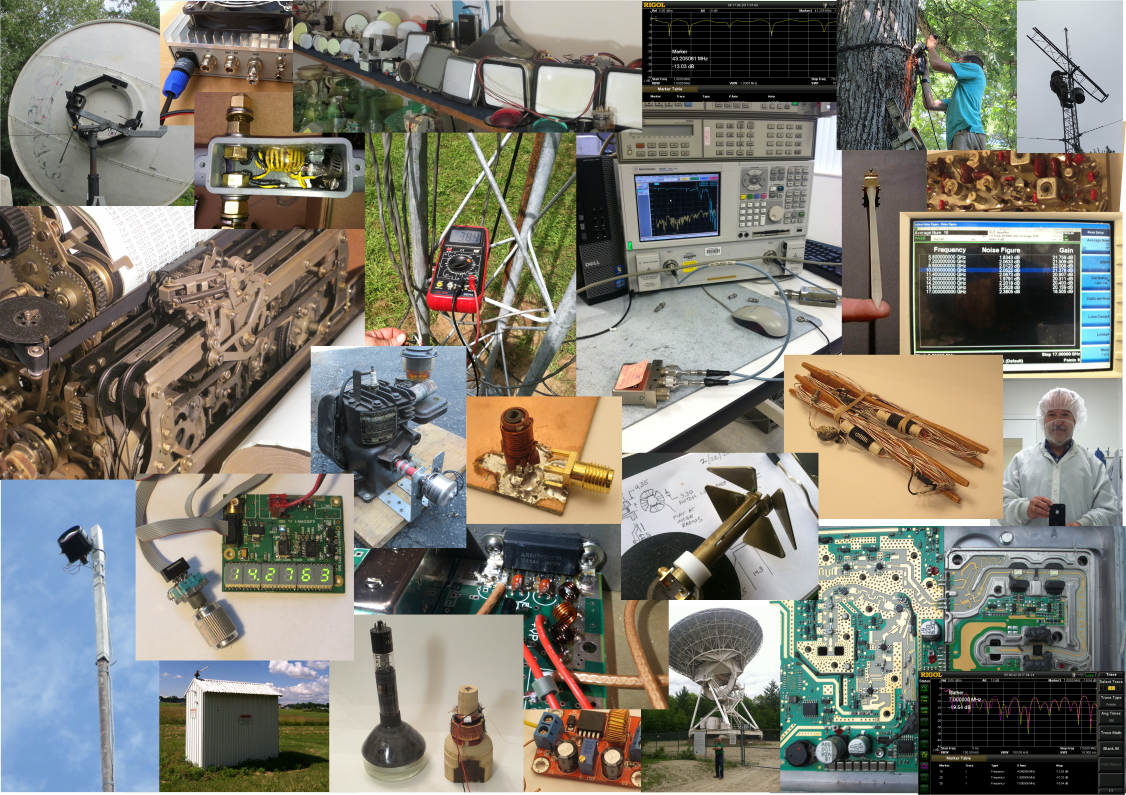
This month’s program will feature “Homebrew Night.” Come in and show off what you’ve been working on over the past year. No project is too small—or too large. If your project is physically too big, don’t fret. Bring along some pictures, JPEG files, or anything else. We’ll find a way to project or display graphics. homebrew, kits, restoration, innovative solutions. Come. Brag. Converse. Have coffee. This is one of the best “social” meetings of the year…

Remember, HB Night and the upcoming Short Subjects Night (the February meeting) both rely on member participation. It’s your hobby; brag about it.

Need directions? Click here and put your own address in box “A”.

Thanks and 73. Please feel free to contact me if you have any questions.

Bruce, K1BG

978-772-2773 or bruce.blain@charter.net

Winter Field Day Event at Cape Ann ARA

CAARA logoTony Sarracino, AB1XK, writes on the CAARA list:

[The Cape Ann Amateur Radio Association] will host Winter Field day on January 25 and 26, 2020. The event will start at 2 PM ET on Saturday, January 25 and end at 2 PM ET on Sunday, January 26.

We encourage all members and their guests to participate. Current plan is to have three transmitters: SSB, PSK31, and CW.

More to follow so save the date.

[See also: Area Radio Clubs QRV for Winter Field Day, January 25-26, 2020]

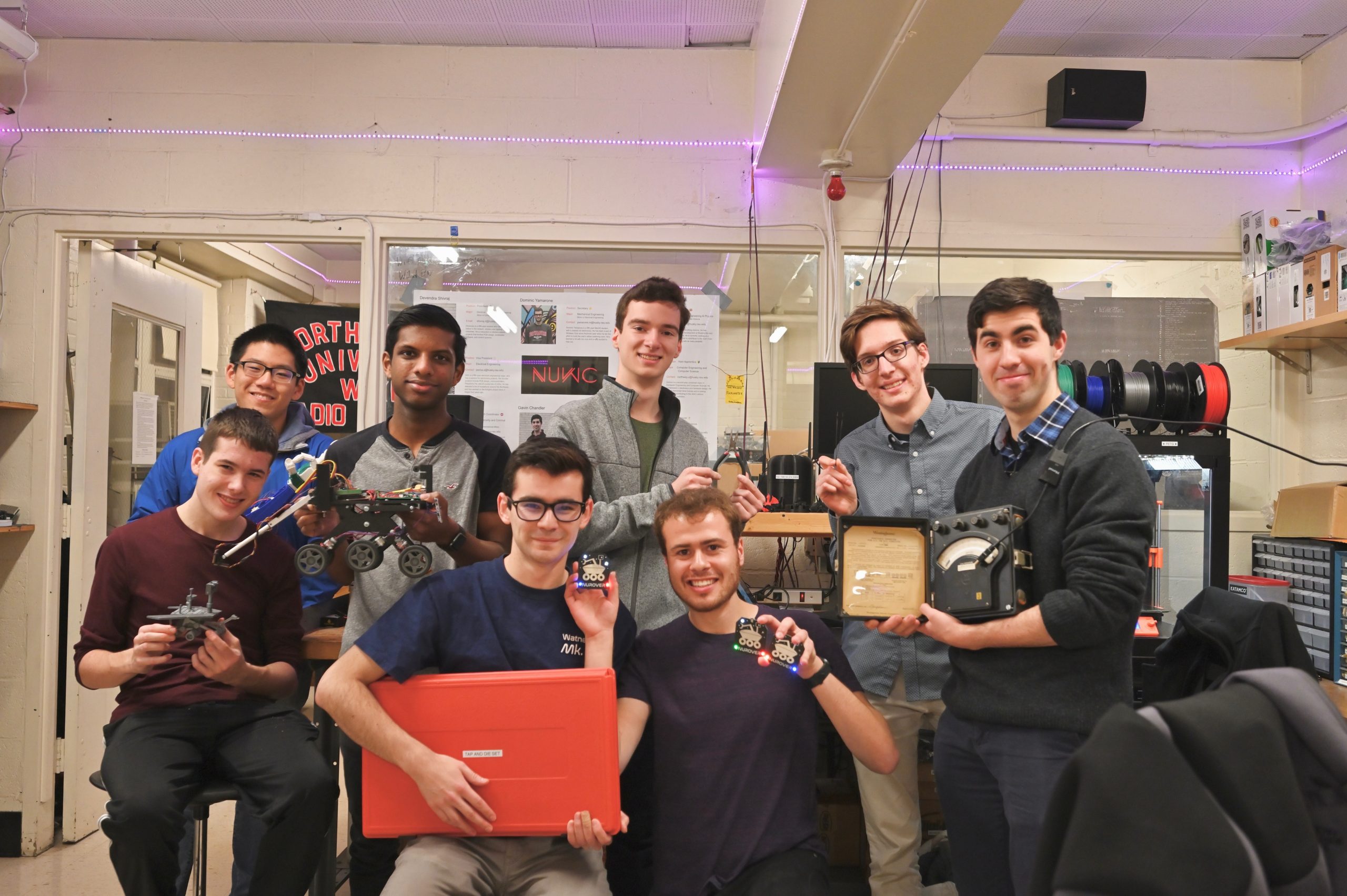
NU Wireless Club Meets January 16, 2020

From the NU Wireless Club mailing list, January 13, 2020:

Welcome back to all of our returning members and new members. After a short winter break, NU Wireless Club is starting back up for the Spring semester. We plan on having bi-weekly general meetings, ham nets, workshops, and project groups.

Our first meeting is this Thursday, January 16th. We will be introducing new members to the club and talking about the upcoming semester. Come join us for pizza and refreshments. Hope to see all of you there!

Our first ham net will be held Monday at 8:00 pm by our resident ham guru, Connor Northway. Here is the information needed to participate:

Output Frequency: 145.31 MHz
Offset: -0.6 MHz
CTCSS (PL) Tone: 123.0 Hz 


Mystic Valley ARG Meets January 19, 2020


Nick Magliano, KC1MA, writes on January 18, 2020 at 3:42 PM:


The meeting scheduled for tomorrow, Sunday, January 19 has been CANCELLED out of concern for safe travel and a storm too close to call. 

MVARG logoNick Magliano, KC1MA writes:

The December meeting of the Mystic Valley Amateur Radio Group will be held on Sunday, January 19, 2019 @ 9 AM.

The meeting location will be the Milton Auxiliary Fire Dept. Station, 2nd floor, 509 Canton Avenue, Milton. The building is a little beyond the gazebo to the right of the Milton Fire Headquarters where we’ve held our Field Day Operations in past years.  Local map is attached below as a post script.

We will be monitoring the 145.43 Belmont repeater for talk-in.  Please feel free to email me with any questions.    kc1ma at arrl dot net

https://www.townofmilton.org/sites/miltonma/files/uploads/towncommontrafficdirectionfinal.pdf

“Framingham residents successful in fight to halt ham radio tower construction. For now.”

From Framingham Wicked Local,

Tower Controversy in Framingham continues
In a unanimous decision, the [Zoning Board of Appeals] voted to vacate the building permit because, in its determination, the ham radio tower Framingham resident Mikhail Filippov wants to build doesn’t comply with local setback requirements as proposed. Filippov’s attorney says he’s waiting for the ZBA’s final opinion before he decides where to take the case next.
FRAMINGHAM – The radio tower that Mikhail Filippov wants to build is 80 feet tall. It would be made of extra-strength steel. It would pick up frequencies that allow him to speak with people as far away as Moscow, even in a communications blackout that cut off phone lines and internet.

Filippov is an amateur ham radio operator who lives at 273 Prospect St., which is where he wants to build the tower. The city issued him a building permit, and Filippov started to pour the foundation.

Then his neighbors found out.

Since then, those neighbors have been mounting a vigorous campaign to halt the project, which they argue would be a dangerous eyesore that scars the neighborhood and hurts families’ nest eggs. On top of all that, the tower as proposed is illegal, they said.

[Full story]


[See also: Neighbors are fighting a Framingham man’s OK to erect an 80-foot ham radio tower”]


Newly-Formed Hudson High School ARC Flourishes Under Teacher’s Guidance

From QRZ.com, W1HUD:

Founded in April of 2019, the Hudson High School Ham Radio Club went on the air with a new club station license as KC1LFV.  Within a few weeks, the FCC issued our new club vanity callsign: W1HUD.

Hudson High School is a public school enrolling about 950 students in grades 8 – 12.  It is located in the New England town of Hudson, MA, about 27 miles (43 km) west of Boston.  We offer a broad general education curriculum, including about 155 elective courses to meet widely varying student interests.  Included among these are courses in digital electronics, robotics, and an advanced AP Physics course in calculus-based electricity and magnetism.

Unlike in years past, most teens today have never even heard of amateur radio, let alone seen a ham station in operation. The HHS Ham Radio Club was formed to address this gap in knowledge, and hopefully to inspire young people to become interested in amateur radio.  

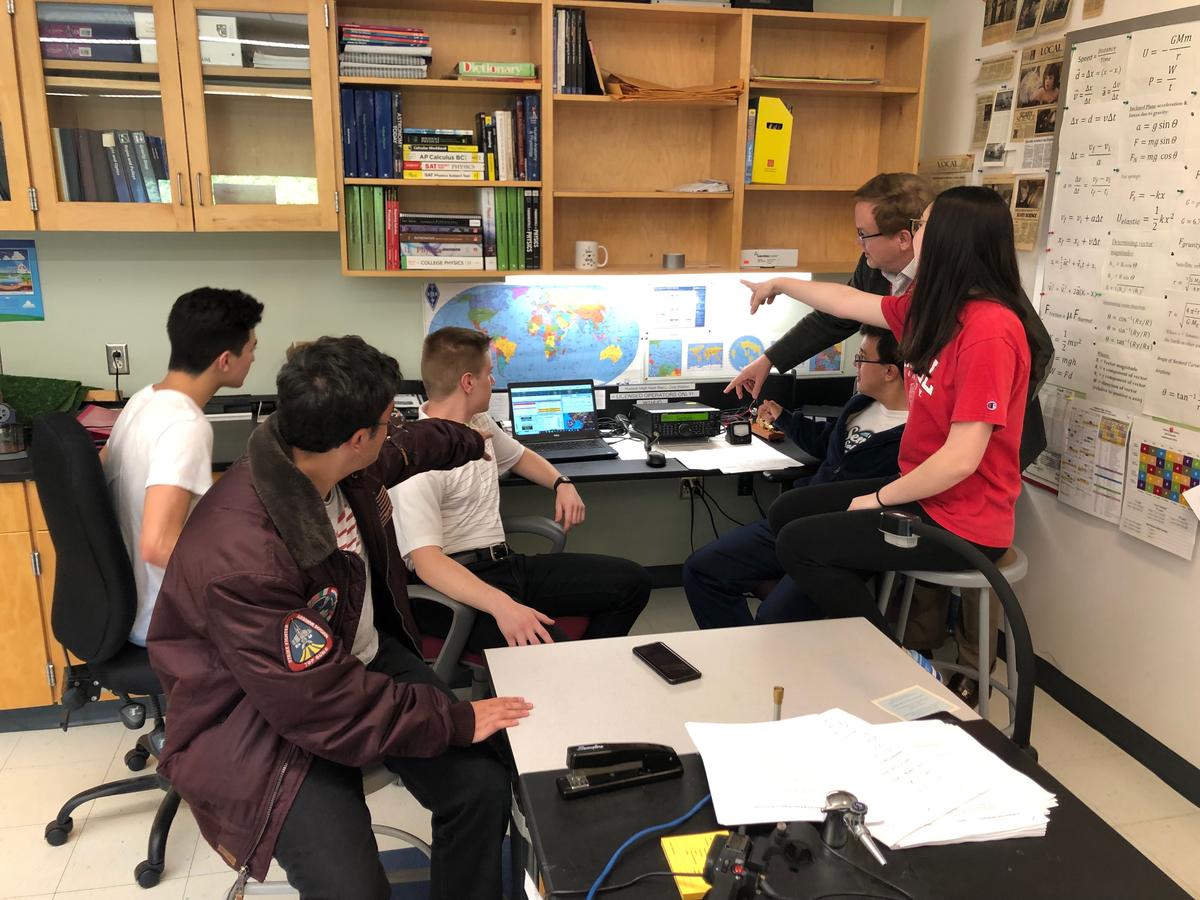
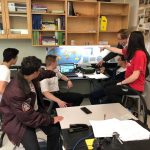
The first “shack” for W1HUD is located right inside the Honors and AP Physics classroom/lab at the high school, where students can try their hand at listening and operating under the close supervision and operational control of the club’s founding trustee Reed Prior (W1TF), who is a physics and astronomy teacher at the school.

The club currently is using a borrowed Kenwood TS-590S transceiver feeding a donated 18 ft tall Hy-Gain 5-band vertical antenna mounted on the building roof.  The roof is made of membrane coated steel, so it provides an excellent counterpoise.

Most operations since inception have been on FT-8 digital using WSJT-X software running on a loaned teacher’s laptop.  Operating in digital mode has proved especially appealing to the students in our situation, since:

  1)  Digital operations are “quiet in the shack” (with the burbling tones turned down on the AF control), so students and the controlling operator can operate the station while other classes are running in the same room.

  2)  Young people these days are . . . well . . . shy about speaking live with strangers.  They’ve grown up in an SMS texting world, where even dating is often done as much by texting each other as by interacting in person!  They seem naturally fascinated by the power of digital communications sans the internet infrastructure.

  3)  With the club’s modest “Little Pistol” station of just 100 watts feeding an omnidirectional vertical antenna, students are amazed by the range of DX stations they can reach this way, even during the day.  Strong signal reports from 10,000 miles away in Australia come to us on 40m and 30m almost every morning.  
W1SEX: “Heath History, the GI Bill, and Economics of Restoration” at Minuteman RA, January 15, 2020

MMRA logoThe Minuteman Repeater Association meeting will feature a presentation by Paul Topolski, W1SEX, entitled, “Heath History, the GI Bill, and Economics of Restoration” on Wednesday, January 15, 2020 at 7:30 PM.  MMRA meets this month in the Leominster Emergency Management Agency Amphitheater, 37 Carter Street, in Leominster, MA 01453.  Directions

“Heath Company was a major player in the electronics industry with hundreds of Heathkit products that educated customers and provided the satisfaction of building and enjoying their own equipment. Heath started with aircraft and transitioned to electronics with test equipment after World War II. Heath added HiFi and ham radio gear within a few years.

“Paul Topolski, W1SEX, of Gardner, Massachusetts will speak about the interesting and colorful history of Heath Company. Paul will speak about the company founder and the subsequent owners of Heath and how the Company’s rapid growth was bolstered by numerous economic factors that came to fruition at the close of World War II. Paul will outline these intertwined factors which lead to tremendous success and the ultimate failure of the company. Finally, Paul will show why Heathkits are among the best ham radio products to restore from both a practical and economical basis.”

N1CPE: “Today’s MARS” at Wellesley ARS, January 21, 2020

The Wellesley Amateur Radio Society will meet on January 21, 2020. Tom Kinahan, N1CPE, will present on “Today’s MARS.”
 
“MARS or ‘Military Auxiliary Radio System’ has changed dramatically since its creation in 1925. Army and Air Force MARS members support a very different mission than you may have heard of before 2010. Every day, MARS members are operating mixed mode voice/data nets using encrypted communications in support of a Department of Defense (DoD) mission to provide situational awareness to DoD planners, in the event of a ‘very bad day’ scenario.  Learn about MARS, and how all Amateurs can support this mission, without joining MARS, and learn how to join MARS, if you have the capability and interest.”


The meeting location for the January meeting at 7:30 PM will be the Wellesley Community Center Hoffman room, 219 Washington Street (at the corner of Route 16 West and Route 9 West). http://www.wellesleycommunitycenter.org/

See YOU there!

Area Radio Clubs QRV for Winter Field Day, January 25-26, 2020

Several area radio clubs have explored plans, or indicated they will participate in the upcoming annual Winter Field Day exercise, January 25-26, 2020. 

The New England Sci-Tech Amateur Radio Society  Amateur Radio Society (STARS) will operate in the event on Saturday, January 25, 2020 from 2 PM to 10 PM. “Open to all licensed amateur radio operators worldwide, Winter Field Day is both a contest and a practice exercise of radio skills. There are hardy individuals who brave the snow and cold and get more points. We will stay warm and take a points loss but still have fun! Non-licensed adults and children can get on the air with one of our control operators. The contest runs 2 pm Saturday to 2 pm Sunday, but we plan to operate publicly only until 10 pm Saturday. Properly licensed radio operators are welcome to continue on their own through the night and into Sunday.”

PART of Westford plans to conduct a Winter Field Day effort led by W1BP at the Westford Sportsmen’s Club on West Street.

The Falmouth Amateur Radio Association discussed the possibility of a club effort in Winter Field Day at a recent monthly meeting. It’s not known whether FARA will actually participate in the event.

 The Winter Field Day event is sponsored by the Winter Field Day Association (WFDA) is a dedicated group of Amateur Radio Operators who believe that emergency communications in a winter environment is just as important as the preparations and practice that is done each summer but with some additional unique operational concerns.

KE1JH: “Infinity, Q, and Transmission Lines, a Physicist’s View” at Dan’s Tech Night, January 9, 2020

Dan Pedtke, KW2T, writes:

TechNight is this Thursday, January 9, 2020, at the usual time and place: 7 PM, Grady Research building [in Ayer].  See the website www.DansTechNight.com for info and directions.

Our guest speaker will be physicist Bob Jackson, KE1JH.  Bob’s talk is “Infinity, Q, and Transmission Lines, a Physicist’s View.” This will be about energy flowing in a transmission line, and characteristic impedance, among other things.

I will not be here for the meeting, I’ll be at the Consumer Electronics Show in Vegas.

KW1U: “Message Handling: An Important Skill in Emergency and Disaster Situations” at Algonquin ARC, January 9, 2020

Algonquin ARC logoThe Algonquin Amateur Radio Club meeting on January 9, 2020, will feature Marcia Forde, KW1U, who will present on “Message Handling: An Important Skill in Emergency and Disaster Situations and the Role of the National Traffic System.” 

AARC’s January newsletter can be read at: <https://www.qsl.net/n1em/QRZ/AARC_Jan_2020.pdf>.

Club meetings are held at 7:30 PM in the library of the 1st Lt. Charles W. Whitcomb Middle School in Marlborough, 25 Union Avenue. Use Door #1 at rear of building.

2020 BAA Marathon Volunteer Registration Now Open

Boston Marathon Communications Committee writes:

On behalf of the BAA Amateur Radio Communications Committee, Happy New Year! It’s hard to believe that 2019 has come to a close and we are heading into 2020. With the New Year comes the 124th running of the Boston Marathon.

Volunteer registration will open for the Marathon January 6th, 2020 at 10:00 a.m. The race itself is taking place on Monday, April 20, 2020.

For Returning Volunteers:

The BAA sends out an email which provides you with a direct link once registration is open. This email will also include your loyalty number, which is required for sign up.

For New Volunteers:

If you haven’t previously volunteered, or have a friend who would like to volunteer, please go directly to the Volunteer Registration page and follow the instructions for new volunteers.

Don’t delay! Volunteer registration closes on Friday, February 7 at 5:00 p.m. Help us get the word out by forwarding this email to your club and other amateur radio operators who wish to volunteer. Most volunteers first learn about the event through word of mouth. If you know new licensees who might like to join us, please make sure to let them know about it. Even just a quick mention at your club meeting can be a big help.

If you have any questions about the upcoming volunteer registration period, or the 2020 Marathon generally, please get in touch anytime. Volunteering at the Marathon is a big job and we appreciate the time and effort everyone puts into it. We’re happy to do what we can to make your work fun, comfortable, and effective.

We look forward to seeing everyone again soon.

Thank you, and 73,

Boston Marathon Communications Committee
contact@HamRadioBoston.org

New England Sci-Tech, STARS Exhibit at AMS Annual Meeting, Boston, January 12, 2020

New England Sci Tech logoNew England Sci-Tech (NEST) / Sci-Tech Amateur Radio Society (STARS) will staff an exhibit at the 19th Annual WeatherFest at the American Meteorological Association Annual Meeting in Boston on Sunday, January 12, 2020 from 12 noon to 4 PM, according to NEST’s Bob Phinney, K5TEC.

According to the WeatherFest web site, “We love to have hands-on, interactive experiments and booths by organizations, university, government, television, radio and private industry.  Exhibit space is free.  All you need to do is staff your booth with enthusiastic people who can capture the imagination and inspire children of all ages.”

MIT Radio Society W1MX Announces January Lecture Series on “Everything Radio”

MIT Radio Society QSL/logoFrom the ARRL Web, 01/02/20:

The Massachusetts Institute of Technology Radio Society (W1MX) and the Department of Electrical Engineering and Computer Science are hosting a lecture series in January that may answer some of your questions about such topics as radar techniques, interferometry, imaging, and radio astronomy, to antenna design and modern chip-scale RF devices. No prior experience with radio is necessary, and all are welcome.

All lectures will take place in the Green Building — MIT’s tallest academic building. Sessions will be live streamed and archived for later viewing.

The lectures kick off on January 10 with “The Next Generation of Weather Radar.” Other topics include “Lightning Interferometry” (January 13); “Radio Noises from the Sky” (January 15); “EDGES: Measuring the Early Universe” (January 22); “Antennas” (January 24), and “Chip-Scale THz Circuits and Sensors” (January 29). Lectures begin at 5 PM ET and conclude at 7 PM.

The club’s Daniel Sheen, KC1EPN, noted that the rooftop W1XM facilities in the Green Building are scheduled for removal as part of a renovation project. A capital campaign is under way to establish a new facility with improved capabilities for academic research and recreational activity.

Eastern MA Amateur Completes 630-meter Transatlantic QSO!

Les Peters, N1SV, writes on the YCCC list:

“After failed attempts both Wednesday [1/1/2020] and Thursday night [1/2/2020], I was finally able to work G0MRF in IO91 (5,269 km) last night [1/3/2020] on 474.2 kHz using JT9-2.  JT9 a popular digital mode on 630m t  sub-modes for different time durations (JT9-2 is 2 minute transmissions with a S/N threshold of -30 dB). 

“My TX antenna is a 160 meter inverted-L with a 200-350 uh bucket variometer and multi-tap impedance transformer.  The RX antenna is a K9AY loop.  My K3S makes about 0 dBm on 630m but with a K5DNL SS PA I have a TPO of about 75 w to make 5 w EIRP from the antenna.”

Ed. note:  Les’ amazing contact is not the first 630-meter transatlanatic contact. From ARRL Web, 12/28/17:

“Radio Amateurs Continue to Plumb the Spectral Depths”

David Bowman, G0MRF, reports that he and Dave Riley, AA1A, have completed what is believed to be the first transatlantic contact on 630 meters since the MF band was released to US radio amateurs this past fall. They used JT9 digital mode to complete the more than 5,160 kilometer (approximately 3,200 miles) contact during the early hours of December 23.